Классификация / Имена
народные названия | синонимы | Catalog of Fishes(род, виды) | ITIS | CoL | WoRMS | Cloffa
>
Gobiiformes (Gobies) >
Gobiidae (Gobies) > Gobiinae
Etymology: Glossogobius: Greek, glossa = tongue + Latin, gobius = gudgeon (Ref. 45335); bellendenensis: Named for the Bellenden Ker Range, where the species was first discovered.
More on authors: Hoese & Allen.
Окружающая среда: среда / климатическая зона / пределы глубины / диапазон распространения
экология
; пресноводный донно-пелагический. Tropical; 17°S - 18°S, 145°E - 146°E
Oceania: Australia, Queensland.
Размер / Вес / Возраст
половая зрелость: Lm ? range ? - ? cm
Max length : 4.3 cm SL самец/пол неопределен; (Ref. 80299)
Краткое описание
определительные ключи | морфология | морфометрия
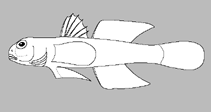
колючие лучи анального плавника: 1; членистые (мягкие) лучи анального плавника: 8. Mental fraenum bilobed, with lateral lobes broad and attached to chin, with a posteromedian
attachment sometimes giving the appearance of a third lobe; predorsal area partly scaled, midline scales extending no farther forward than posterior preopercular margin; cheek, operculum, pectoral base, prepelvic area and anterior midline of belly naked; first dorsal fin with one or two large black spots posteriorly; second dorsal-fin rays usually I,10; anal-fin rays I,8; pectoral-fin rays usually 16–17; predorsal scale count 2–14; cheek papilla lines composed of single row of papillae; papilla line 6 absent and vertebrae usually 12+16.Glossogobius bellendenensis is readily distinguished from other species of Glossogobius in dorsal and anal-ray counts, reduced predorsal scale coverage, absence of scales of prepelvic area and pectoral base and distinctive shape of the mental frenum. It shares most of those characteristics with Glossogobius muscorum from the Fly River in New Guinea. Glossogobius bellendensis differs from that species in coloration, in usually having 12+16 vertebrae (versus 11+17), and a trilobed mental frenum (versus bilobed). The coloration differences include lacking a horizontal brown stripe on the cheek below the eye, an oval brown spot on the anteromedian margin of the operculum and white on the posterior end of lips, characteristic of G. muscorum. It addition there are two large spots on the midside on the belly (versus one large blotch on the side of the belly).
The species can be confused with Glossogobius concavifrons, which has scales on the pectoral base and prepelvic area, predorsal scales reaching to near eye, more numerous precaudal vertebrae (13–15) and more compressed head. Currently the two species are not known to be sympatric. Glossogobius concavifrons is known from rivers of western Cape York to Arnhem Land in Australia and southern New Guinea. Separation of juveniles below 20 mm SL is difficult because the scales are not well developed in Glossogobius concavifrons at that size.
Body shape (shape guide): fusiform / normal.
Kroon and Johnson (2006) document Queensland records of this species. Although the species currently is restricted in its distribution, it may have been mistaken for juveniles of other species because of the small size of the species. Consequently it is likely to be more widely distributed in Australia (Ref. 80299).
Жизненный цикл и брачное поведение
половая зрелость | размножение | нерест | икра | Плодовитость | личинки
Hoese, D.F. and G.R. Allen, 2009. Description of three new species of Glossogobius from Australia and New Guinea. Zootaxa 1981:1-14. (Ref. 80299)
Статус Красного Списка МСОП (Ref. 130435: Version 2025-2 (Global))
Угроза для людей
Harmless
Использование человеком
дополнительная информация
инструменты
Специальные отчеты
Скачать в формате XML
ресурсы в Интернет
Оценки, основанные на моделях
Индекс филогенетического разнообразия (ссылка
82804): PD
50 = 0.5000 [Uniqueness, from 0.5 = low to 2.0 = high].
Bayesian length-weight: a=0.01023 (0.00477 - 0.02194), b=3.01 (2.83 - 3.19), in cm total length, based on LWR estimates for this (Sub)family-body shape (Ref.
93245).
Трофический уровень (ссылка
69278): 3.3 ±0.4 se; based on size and trophs of closest relatives
устойчивость к внешним воздействиям (ссылка
120179): высокий, минимальное время удвоения популяции до 15 месяцев (Preliminary K or Fecundity.).
Уязвимость рыбной ловли (Ref.
59153): Low vulnerability (10 of 100).
🛈