Clasificación / Nombres
Nombres comunes | Sinónimos | Catalog of Fishes(Género, Especie) | ITIS | CoL | WoRMS | Cloffa
>
Gobiiformes (Gobies) >
Gobiidae (Gobies) > Gobiinae
Etymology: Glossogobius: Greek, glossa = tongue + Latin, gobius = gudgeon (Ref. 45335); bellendenensis: Named for the Bellenden Ker Range, where the species was first discovered.
More on authors: Hoese & Allen.
Entorno: milieu / zona climática / rango de profundidad / gama de distribución
Ecología
; agua dulce bentopelágico. Tropical; 17°S - 18°S, 145°E - 146°E
Oceania: Australia, Queensland.
Tamaño / Peso / Edad
Madurez: Lm ? range ? - ? cm
Max length : 4.3 cm SL macho / no sexado; (Ref. 80299)
Descripción breve
Claves de identificación | Morfología | Morfometría
Espinas anales: 1; Radios blandos anales: 8. Mental fraenum bilobed, with lateral lobes broad and attached to chin, with a posteromedian
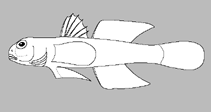
attachment sometimes giving the appearance of a third lobe; predorsal area partly scaled, midline scales extending no farther forward than posterior preopercular margin; cheek, operculum, pectoral base, prepelvic area and anterior midline of belly naked; first dorsal fin with one or two large black spots posteriorly; second dorsal-fin rays usually I,10; anal-fin rays I,8; pectoral-fin rays usually 16–17; predorsal scale count 2–14; cheek papilla lines composed of single row of papillae; papilla line 6 absent and vertebrae usually 12+16.Glossogobius bellendenensis is readily distinguished from other species of Glossogobius in dorsal and anal-ray counts, reduced predorsal scale coverage, absence of scales of prepelvic area and pectoral base and distinctive shape of the mental frenum. It shares most of those characteristics with Glossogobius muscorum from the Fly River in New Guinea. Glossogobius bellendensis differs from that species in coloration, in usually having 12+16 vertebrae (versus 11+17), and a trilobed mental frenum (versus bilobed). The coloration differences include lacking a horizontal brown stripe on the cheek below the eye, an oval brown spot on the anteromedian margin of the operculum and white on the posterior end of lips, characteristic of G. muscorum. It addition there are two large spots on the midside on the belly (versus one large blotch on the side of the belly).
The species can be confused with Glossogobius concavifrons, which has scales on the pectoral base and prepelvic area, predorsal scales reaching to near eye, more numerous precaudal vertebrae (13–15) and more compressed head. Currently the two species are not known to be sympatric. Glossogobius concavifrons is known from rivers of western Cape York to Arnhem Land in Australia and southern New Guinea. Separation of juveniles below 20 mm SL is difficult because the scales are not well developed in Glossogobius concavifrons at that size.
Body shape (shape guide): fusiform / normal.
Kroon and Johnson (2006) document Queensland records of this species. Although the species currently is restricted in its distribution, it may have been mistaken for juveniles of other species because of the small size of the species. Consequently it is likely to be more widely distributed in Australia (Ref. 80299).
Ciclo vital y comportamiento de apareamiento
Madurez | Reproducción | Puesta | Huevos | Fecundidad | Larva
Hoese, D.F. and G.R. Allen, 2009. Description of three new species of Glossogobius from Australia and New Guinea. Zootaxa 1981:1-14. (Ref. 80299)
Situación en la Lista Roja de la UICN (Ref. 130435: Version 2025-2 (Global))
Amenaza para el ser humano
Harmless
Usos humanos
Herramientas
Informes especiales
Descargar XML
Fuentes de Internet
Estimaciones basadas en modelos
Índice de diversidad filogenética (Referencia
82804): PD
50 = 0.5000 [Uniqueness, from 0.5 = low to 2.0 = high].
Bayesian length-weight: a=0.01023 (0.00477 - 0.02194), b=3.01 (2.83 - 3.19), in cm total length, based on LWR estimates for this (Sub)family-body shape (Ref.
93245).
Nivel trófico (Referencia
69278): 3.3 ±0.4 se; based on size and trophs of closest relatives
Resiliencia (Referencia
120179): Alto, población duplicada en un tiempo mínimo inferior a 15 meses (Preliminary K or Fecundity.).
Vulnerabilidad pesquera (Ref.
59153): Low vulnerability (10 of 100).
🛈