Классификация / Имена
народные названия | синонимы | Catalog of Fishes(род, виды) | ITIS | CoL | WoRMS | Cloffa
>
Perciformes/Percoidei (Perchs) >
Percidae (Perches) > Etheostomatinae
Etymology: Etheostoma: Greek, etheo = to strain + Greek, stoma = mouth; Rafinesque said "various mouths", but Jordan and Evermann suggest the name might have been intended as "Heterostoma (Ref. 45335); erythrozonum: The name erythrozonum is derived from Greek: erythros, red, and zona, zone. This name is in reference to the red-orange stripe and lateral red-orange blotches characteristic of this species, and the name is
in keeping with the names.
Окружающая среда: среда / климатическая зона / пределы глубины / диапазон распространения
экология
; пресноводный донно-пелагический. Temperate; 39°N - 37°N, 90°W - 92°W
North America: USA. Etheostoma erythrozonum is restricted to the Meramec River drainage of Missouri. It is widely distributed within the Meramec River drainage, known from the main channel of the Meramec River in St. Louis County and upstream into larger tributaries. It is generally absent from small headwater streams (Ref. 80465).
Размер / Вес / Возраст
половая зрелость: Lm ? range ? - ? cm
Max length : 7.1 cm SL самец/пол неопределен; (Ref. 80865)
Краткое описание
определительные ключи | морфология | морфометрия
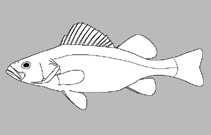
Etheostoma erythrozonum is a relatively large, stout-bodied species of Etheostoma.
Dorsal-fin spines (11–14, modally 13), dorsal-fin rays (12–14, modally 13), anal-fin rays (8–10, modally 9), principal caudal rays (16–18, modally 17), pectoral-fin rays (15–17, modally 16), lateral-line scales (39–55, modally 50), cheek scales absent, opercle partially scaled (0–9 scales, modally 5), breast partially to completely scaled, nape completely scaled. Both males and females of this species have four prominent dark saddles on the back and dorsal sides, with the sides angled obliquely forward. The background color is dusky in the dorsal region, lighter in the sublateral region and white on the belly. Along the sides is a series of sub-lateral dark blotches. There is a dark
preorbital bar extending forward and a dark suborbital bar extending down the cheek. This species exhibits extreme sexual dimorphism in nuptial color patterns.
Body shape (shape guide): elongated.
Etheostoma erythrozonum is one of the most abundant darters within its range; its conservation status is currently considered stable (Ref. 49982 and Ref. 80865).
Жизненный цикл и брачное поведение
половая зрелость | размножение | нерест | икра | Плодовитость | личинки
Switzer, J.F. and R.M. Wood, 2009. Etheostoma erythrozonum, a new species of darter (Teleostei: Percidae) from the Meramec River drainage, Missouri. Zootaxa 2095:1-7. (Ref. 80865)
Статус Красного Списка МСОП (Ref. 130435: Version 2025-2 (Global))
Угроза для людей
Harmless
Использование человеком
дополнительная информация
инструменты
Специальные отчеты
Скачать в формате XML
ресурсы в Интернет
Оценки, основанные на моделях
Индекс филогенетического разнообразия (ссылка
82804): PD
50 = 0.5000 [Uniqueness, from 0.5 = low to 2.0 = high].
Bayesian length-weight: a=0.00676 (0.00303 - 0.01510), b=3.12 (2.94 - 3.30), in cm total length, based on LWR estimates for this Genus-body shape (Ref.
93245).
Трофический уровень (ссылка
69278): 3.3 ±0.5 se; based on size and trophs of closest relatives
устойчивость к внешним воздействиям (ссылка
120179): высокий, минимальное время удвоения популяции до 15 месяцев (Preliminary K or Fecundity.).
Уязвимость рыбной ловли (Ref.
59153): Low vulnerability (10 of 100).
🛈