>
Perciformes/Percoidei (Perchs) >
Percidae (Perches) > Etheostomatinae
Etymology: Etheostoma: Greek, etheo = to strain + Greek, stoma = mouth; Rafinesque said "various mouths", but Jordan and Evermann suggest the name might have been intended as "Heterostoma (Ref. 45335); erythrozonum: The name erythrozonum is derived from Greek: erythros, red, and zona, zone. This name is in reference to the red-orange stripe and lateral red-orange blotches characteristic of this species, and the name is
in keeping with the names.
Entorno: milieu / zona climática / rango de profundidad / gama de distribución
Ecología
; agua dulce bentopelágico. Temperate; 39°N - 37°N, 90°W - 92°W
North America: USA. Etheostoma erythrozonum is restricted to the Meramec River drainage of Missouri. It is widely distributed within the Meramec River drainage, known from the main channel of the Meramec River in St. Louis County and upstream into larger tributaries. It is generally absent from small headwater streams (Ref. 80465).
Tamaño / Peso / Edad
Madurez: Lm ? range ? - ? cm
Max length : 7.1 cm SL macho / no sexado; (Ref. 80865)
Descripción breve
Claves de identificación | Morfología | Morfometría
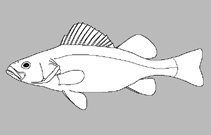
Etheostoma erythrozonum is a relatively large, stout-bodied species of Etheostoma.
Dorsal-fin spines (11–14, modally 13), dorsal-fin rays (12–14, modally 13), anal-fin rays (8–10, modally 9), principal caudal rays (16–18, modally 17), pectoral-fin rays (15–17, modally 16), lateral-line scales (39–55, modally 50), cheek scales absent, opercle partially scaled (0–9 scales, modally 5), breast partially to completely scaled, nape completely scaled. Both males and females of this species have four prominent dark saddles on the back and dorsal sides, with the sides angled obliquely forward. The background color is dusky in the dorsal region, lighter in the sublateral region and white on the belly. Along the sides is a series of sub-lateral dark blotches. There is a dark
preorbital bar extending forward and a dark suborbital bar extending down the cheek. This species exhibits extreme sexual dimorphism in nuptial color patterns.
Body shape (shape guide): elongated.
Etheostoma erythrozonum is one of the most abundant darters within its range; its conservation status is currently considered stable (Ref. 49982 and Ref. 80865).
Ciclo vital y comportamiento de apareamiento
Madurez | Reproducción | Puesta | Huevos | Fecundidad | Larva
Switzer, J.F. and R.M. Wood, 2009. Etheostoma erythrozonum, a new species of darter (Teleostei: Percidae) from the Meramec River drainage, Missouri. Zootaxa 2095:1-7. (Ref. 80865)
Situación en la Lista Roja de la UICN (Ref. 130435: Version 2025-2 (Global))
Amenaza para el ser humano
Harmless
Usos humanos
Herramientas
Informes especiales
Descargar XML
Fuentes de Internet
Estimaciones basadas en modelos
Índice de diversidad filogenética (Referencia
82804): PD
50 = 0.5000 [Uniqueness, from 0.5 = low to 2.0 = high].
Bayesian length-weight: a=0.00676 (0.00303 - 0.01510), b=3.12 (2.94 - 3.30), in cm total length, based on LWR estimates for this Genus-body shape (Ref.
93245).
Nivel trófico (Referencia
69278): 3.3 ±0.5 se; based on size and trophs of closest relatives
Resiliencia (Referencia
120179): Alto, población duplicada en un tiempo mínimo inferior a 15 meses (Preliminary K or Fecundity.).
Vulnerabilidad pesquera (Ref.
59153): Low vulnerability (10 of 100).
🛈