Entorno: milieu / zona climática / rango de profundidad / gama de distribución
Ecología
; agua dulce; salobre bentopelágico. Temperate; 1°C - 17°C (Ref. 59043)
Eurasia: Northern and northwestern Caspian Sea; enters Volga, Ural, Emba, Terek and Kura drainages for spawning.
Tamaño / Peso / Edad
Madurez: Lm ? range ? - ? cm
Max length : 45.0 cm SL macho / no sexado; (Ref. 59043); peso máximo publicado: 2.0 kg (Ref. 59043); edad máxima reportada: 10 años (Ref. 59043)
Descripción breve
Claves de identificación | Morfología | Morfometría
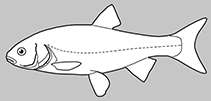
Can be diagnosed from its congeners in Caspian Sea basin by having the following characters: 39-48 (usually 42-44) scales along the lateral line; body laterally compressed, depth 24-37% SL; dorsal fin usually with 9½ branched rays; anal fin usually with 10½ branched rays; mouth subterminal; snout rounded; iris silvery grey; pectoral pelvic and anal fins grey with dark margins (sometimes slightly red in autumn, outside spawning season); breeding males with fine, scattered tubercles on top and side of head (Ref. 59043)
A semi-anadromous species which occurs mostly in shallow brackish coastal waters. During summer at the sea, adults are most abundant at water depth of 2.5-4.0 m and salinity of 2-4 ppt. Enters freshwater of estuaries, lagoons and lower reaches of large rivers to spawn. In rivers, juveniles take plankton (mostly Cladocera) and small benthic animals as food. At the sea, they feed on oligochaetes, chironomid larvae and algae. Adults also prey on crustaceans, worms and chironomids larvae. Spawns on shallow shores of coastal lakes and flooded areas. After spawning adult move back to the sea to join groups of immature juveniles, not traveling for long distances, staying in areas with high abundance of prey. Larvae migrate to the sea (Ref. 59043).
Ciclo vital y comportamiento de apareamiento
Madurez | Reproducción | Puesta | Huevos | Fecundidad | Larva
Deposits sticky eggs among plants. An annual spawner, but some females spawn only every second year (Ref. 59043)
Kottelat, M. and J. Freyhof, 2007. Handbook of European freshwater fishes. Publications Kottelat, Cornol and Freyhof, Berlin. 646 pp. (Ref. 59043)
Situación en la Lista Roja de la UICN (Ref. 130435: Version 2025-2 (Global))
Amenaza para el ser humano
Harmless
Usos humanos
Herramientas
Informes especiales
Descargar XML
Fuentes de Internet
Estimaciones basadas en modelos
Índice de diversidad filogenética (Referencia
82804): PD
50 = 0.5020 [Uniqueness, from 0.5 = low to 2.0 = high].
Bayesian length-weight: a=0.00724 (0.00353 - 0.01485), b=3.14 (2.97 - 3.31), in cm total length, based on LWR estimates for this (Sub)family-body shape (Ref.
93245).
Nivel trófico (Referencia
69278): 3.4 ±0.40 se; based on food items.
Resiliencia (Referencia
120179): Bajo, población duplicada en un tiempo mínimo de 4.5-14 años (tm=2-5).
Vulnerabilidad pesquera (Ref.
59153): Moderate vulnerability (42 of 100).
🛈