Classificação / Nomes
Nomes comuns | Sinónimos | Catalog of Fishes(Género, Espécies) | ITIS | CoL | WoRMS | Cloffa
>
Siluriformes (Catfishes) >
Loricariidae (Armored catfishes) > Loricariinae
Etymology: Loricaria: Latin, lorica, loricare = cuirass of corslet of leather; 1706 + Greek, ichthys = fish (Ref. 45335).
Eponymy: Dr José Luís Olivan Birindelli (d: 1979) is a Brazilian ichthyologist. [...] (Ref. 128868), visit book page.
Ambiente: milieu / zona climática / intervalo de profundidade / gama de distribuição
Ecologia
; Água doce demersal. Tropical; 8°S - 9°S, 55°W - 56°W
South America: Brazil, Pará, Altamira Municipality, Rio Curuá, Iriri-Xingu drainage, near town of Castelo dos Sonhos (Ref. 84258).
Tamanho / Peso / Idade
Maturidade: Lm ? range ? - ? cm
Max length : 36.5 cm TL macho/indeterminado; (Ref. 111518); peso máx. Publicado: 118.20 g (Ref. 111518)
Descrição breve
Chaves de identificação | Morfologia | Morfometria
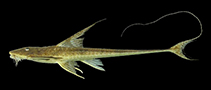
In adults Loricaria birindellii is distinguished from all other nominal species of Loricaria by having a combination of an elongate dorsal-fin spine (36.0% SL based on the holotype vs. 16–29%, usually less than 26% SL) that is supported throughout most of its length by the first branched ray and an inconspicuous (vs. prominent) post-orbital notch with minimum orbital diameter 95.4–97.2% (vs. 71.8–91.5%) of maximum orbital diameter. It is further distinguished from similar and geographically proximate species, L. lata and L. simillima, by having a narrower head width (13.9–14.9% SL vs. 15.2–19.4% SL in L. simillima and 16.4–20.1% SL in L. lata), from L. clavipinna by having more divergent plates (21 vs. 18–19) and fewer coalesced plates (13 vs. 15–16) in the lateral series, and from L. cataphracta by having weakly (vs. strongly) developed odontode crests on head and dorsal trunk plates, more divergent plates (21 vs. 17–20, usually 19) and fewer coalesced plates (13 vs. 13–17, usually 15–16) in the lateral series (Ref. 84258).
Body shape (shape guide): elongated.
Facultative air-breathing in the genus (Ref. 126274)
Ciclo de vida e comportamento de acasalamento
Maturidade | Reprodução | Desova | Ovos | Fecundidade | Larvas
Thomas, M.R. and M.H. Sabaj Pérez, 2010. A new species of whiptail catfish, genus Loricaria (Siluriformes: Loricariidae), from the Rio Curua´ (Xingu Basin), Brazil. Copeia 2010(2):274-283. (Ref. 84258)
Categoria na Lista Vermelha da IUCN (Ref. 130435: Version 2025-2 (Global))
Ameaça para o homem
Harmless
Utilização humana
Ferramentas
Relatórios especiais
Descarregue XML
Fontes da internet
Estimativas baseadas em modelos
Índice de diversidade filogenética (Ref.
82804): PD
50 = 0.5000 [Uniqueness, from 0.5 = low to 2.0 = high].
Bayesian length-weight: a=0.00302 (0.00168 - 0.00543), b=3.05 (2.90 - 3.20), in cm total length, based on LWR estimates for this species & (Sub)family-body (Ref.
93245).
Nível Trófico (Ref.
69278): 2.4 ±0.2 se; based on size and trophs of closest relatives
Resiliência (Ref.
120179): Médio, tempo mínimo de duplicação da população 1,4 - 4,4 anos (Preliminary K or Fecundity.).
Vulnerabilidade da pesca (Ref.
59153): Low to moderate vulnerability (27 of 100).
🛈