Clasificación / Nombres
Nombres comunes | Sinónimos | Catalog of Fishes(Género, Especie) | ITIS | CoL | WoRMS | Cloffa
>
Siluriformes (Catfishes) >
Loricariidae (Armored catfishes) > Loricariinae
Etymology: Loricaria: Latin, lorica, loricare = cuirass of corslet of leather; 1706 + Greek, ichthys = fish (Ref. 45335).
Eponymy: Dr José Luís Olivan Birindelli (d: 1979) is a Brazilian ichthyologist. [...] (Ref. 128868), visit book page.
Entorno: milieu / zona climática / rango de profundidad / gama de distribución
Ecología
; agua dulce demersal. Tropical; 8°S - 9°S, 55°W - 56°W
South America: Brazil, Pará, Altamira Municipality, Rio Curuá, Iriri-Xingu drainage, near town of Castelo dos Sonhos (Ref. 84258).
Tamaño / Peso / Edad
Madurez: Lm ? range ? - ? cm
Max length : 36.5 cm TL macho / no sexado; (Ref. 111518); peso máximo publicado: 118.20 g (Ref. 111518)
Descripción breve
Claves de identificación | Morfología | Morfometría
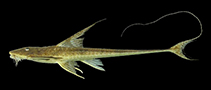
In adults Loricaria birindellii is distinguished from all other nominal species of Loricaria by having a combination of an elongate dorsal-fin spine (36.0% SL based on the holotype vs. 16–29%, usually less than 26% SL) that is supported throughout most of its length by the first branched ray and an inconspicuous (vs. prominent) post-orbital notch with minimum orbital diameter 95.4–97.2% (vs. 71.8–91.5%) of maximum orbital diameter. It is further distinguished from similar and geographically proximate species, L. lata and L. simillima, by having a narrower head width (13.9–14.9% SL vs. 15.2–19.4% SL in L. simillima and 16.4–20.1% SL in L. lata), from L. clavipinna by having more divergent plates (21 vs. 18–19) and fewer coalesced plates (13 vs. 15–16) in the lateral series, and from L. cataphracta by having weakly (vs. strongly) developed odontode crests on head and dorsal trunk plates, more divergent plates (21 vs. 17–20, usually 19) and fewer coalesced plates (13 vs. 13–17, usually 15–16) in the lateral series (Ref. 84258).
Body shape (shape guide): elongated.
Facultative air-breathing in the genus (Ref. 126274)
Ciclo vital y comportamiento de apareamiento
Madurez | Reproducción | Puesta | Huevos | Fecundidad | Larva
Thomas, M.R. and M.H. Sabaj Pérez, 2010. A new species of whiptail catfish, genus Loricaria (Siluriformes: Loricariidae), from the Rio Curua´ (Xingu Basin), Brazil. Copeia 2010(2):274-283. (Ref. 84258)
Situación en la Lista Roja de la UICN (Ref. 130435: Version 2025-2 (Global))
Amenaza para el ser humano
Harmless
Usos humanos
Herramientas
Informes especiales
Descargar XML
Fuentes de Internet
Estimaciones basadas en modelos
Índice de diversidad filogenética (Referencia
82804): PD
50 = 0.5000 [Uniqueness, from 0.5 = low to 2.0 = high].
Bayesian length-weight: a=0.00302 (0.00168 - 0.00543), b=3.05 (2.90 - 3.20), in cm total length, based on LWR estimates for this species & (Sub)family-body (Ref.
93245).
Nivel trófico (Referencia
69278): 2.4 ±0.2 se; based on size and trophs of closest relatives
Resiliencia (Referencia
120179): Medio, población duplicada en un tiempo mínimo de 1.4-4.4 años (Preliminary K or Fecundity.).
Vulnerabilidad pesquera (Ref.
59153): Low to moderate vulnerability (27 of 100).
🛈