Ikan bertulang rawan (sharks and rays) >
Orectolobiformes (Carpet sharks) >
Orectolobidae (Carpet or nurse sharks)
Etymology: Orectolobus: orektos (Gr.), stretched out; lobus (L.), from lobos (Gr.), rounded projection or protuberance, referring to long nasal barbels of Squalus barbatus (=O. maculatus) (See ETYFish); leptolineatus: leptos (Gr.) fine or thin; lineatus (L.), lined, referring to thin, vermicular markings on dorsal surface (See ETYFish).
More on authors: Last, Pogonoski & White.
Lingkungan: lingkungan / zona iklim / kisaran kedalaman / jangkauan distribusi
Ekologi
laut bentopelagis; kisaran kedalaman 20 - 110 m (Ref. 126634). Tropical
Western Pacific: Indonesia (Ref. 84278); also from off Sarawak Malaysian (Borneo), and with unconfirmed records from Taiwan (Penghu Islands), and the Philippines (Visayas and Cebu City), Ryukyu Islands (Ref. 90102).
Ukuran / Berat / umur
Kematangan: Lm ? range ? - ? cm
Max length : 112 cm TL jantan/; (Ref. 84278); 120.0 cm TL (female)
deskripsi pendek
Kunci identifiaksi (pengenalan) | Morfologi | Morfometrik
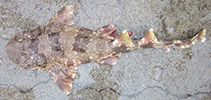
This medium-sized (to at least 120 cm TL) Orectolobus species is distinguished by the following set of characters: coloration complex and variable, strongly vermiculate over dorsal and lateral surfaces with alternating dark brownish bars and saddles; dorsal and upper surface of paired fins with prominent vermicular patterns; ventral surface of trunk mainly uniformly pale; nasal barbel with a branch; preorbital dermal lobes complex, with 2-3 simple lobes in PO1 group and 3-4 simple to terminally branched lobes in PO2; simple postspiracular dermal lobes, well- developed, thallate, distance across preorbital group 1.3-1.6 times interspace between preorbital group and postspiracular lobe (PO/PO-PS1), 6.5-8.0 times base length of anterior postspiracular lobe (PO/PS1); base of anterior postspiracular lobe 4.3-5.3 in its distance from postorbital group (PO-PS1/PS1), 2.5-2.9 in its distance from posterior postspiracular lobe (PS1-PS2/PS1); enlarged supraocular knob or warty tubercles on back absent; dorsal fins tall, upright; first dorsal-fin origin near insertion of pelvic fin; tip of pelvic fin below insertion of first dorsal fin; interdorsal space 0.5-0.8 times anal-fin base length; anal-fin inner margin 0.7-0.8 of anal-fin posterior margin; 23 tooth rows in upper jaw, rudimentary row of teeth at symphysis of upper jaw usually present; monospondylous centra 44-51; total vertebral centra about 148-163 (Ref. 84278).
Body shape (shape guide): elongated.
The depth range of this species is not well defined; specimens observed at fish markets
were presumably caught by longline fishers operating in deeper parts of the continental shelf. It probably prefers deeper colder water with a single shallow water observation from the east
coast of Bali where cold-water upwelling is common. All males (n = 43) mature by ca 90 cm TL; smallest mature female recorded at 94 cm TL, two pregnant females recorded at 104 and 108 cm TL, smaller of the two pregnant females contained 4 mid-term embryos between 13 and 14 cm TL (Ref. 84278).
Siklus hidup dan perilaku kawin
Kematangan | Reproduksi, perkembang biakan | Pemijahan | telur-telur | Fekunditas | Larva
Last, P.R., J.J. Pogonoski and W.T. White, 2010. A new wobbegong shark, Orectolobus leptolineatus sp. nov. (Orectolobiformes: Orectolobidae), from the Western Central Pacific. pp. 1-16. In Last, P.R., White, W.T. & Pogonoski, J.J. (eds.): Descriptions of new sharks and rays from Borneo. CSIRO Marine and Atmospheric Research Paper no. 32. (Ref. 84278)
Status IUCN Red List (Ref. 130435: Version 2025-2 (Global))
ancaman kepada manusia
Harmless
penggunaan manusia
Alat, peralatan
laporan khas
muat turun XML
Sumber internet
Estimasi berdasarkan model
Indeks keanekaragaman filogenetik (Acuan
82804): PD
50 = 0.5012 [Uniqueness, from 0.5 = low to 2.0 = high].
Bayesian length-weight: a=0.00389 (0.00180 - 0.00842), b=3.12 (2.94 - 3.30), in cm total length, based on all LWR estimates for this body shape (Ref.
93245).
Tingkat Trofik (Acuan
69278): 3.9 ±0.6 se; based on size and trophs of closest relatives
Kerentanan Penangkapan Ikan (Ref.
59153): High to very high vulnerability (72 of 100).
🛈