This website uses cookies to enhance your browsing experience and ensure the functionality of our site. For more detailed information about the types of cookies we use and how we protect your privacy, please visit our Privacy Information page.
×
Cookie Settings
This website uses different types of cookies to enhance your experience. Please select your preferences below:
分類 / 名前 共通名の | 類義語 | Catalog of Fishes(部類, 種) | ITIS | CoL | WoRMS | Cloffa
板鰓亜鋼(サメとエイ類) (sharks and rays) > Orectolobiformes (Carpet sharks) > Orectolobidae (Carpet or nurse sharks)
Etymology: Orectolobus:orektos (Gr.), stretched out; lobus (L.), from lobos (Gr.), rounded projection or protuberance, referring to long nasal barbels of Squalus barbatus (=O. maculatus) (See ETYFish); leptolineatus:leptos (Gr.) fine or thin; lineatus (L.), lined, referring to thin, vermicular markings on dorsal surface (See ETYFish). More on authors: Last, Pogonoski & White.
環境:環境 / 気候帯 / 深さの範囲 / 分布範囲 生態学
海 底生の漂泳性; 深さの範囲 20 - 110 m (Ref. 126634). Tropical
Western Pacific: Indonesia (Ref. 84278); also from off Sarawak Malaysian (Borneo), and with unconfirmed records from Taiwan (Penghu Islands), and the Philippines (Visayas and Cebu City), Ryukyu Islands (Ref. 90102).
サイズ / 重さ / 年齢
成熟: Lm? range ? - ? cm Max length : 112 cm TL オス/雌雄の選別がない; (Ref. 84278); 120.0 cm TL (female)
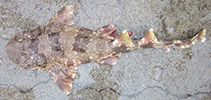
This medium-sized (to at least 120 cm TL) Orectolobus species is distinguished by the following set of characters: coloration complex and variable, strongly vermiculate over dorsal and lateral surfaces with alternating dark brownish bars and saddles; dorsal and upper surface of paired fins with prominent vermicular patterns; ventral surface of trunk mainly uniformly pale; nasal barbel with a branch; preorbital dermal lobes complex, with 2-3 simple lobes in PO1 group and 3-4 simple to terminally branched lobes in PO2; simple postspiracular dermal lobes, well- developed, thallate, distance across preorbital group 1.3-1.6 times interspace between preorbital group and postspiracular lobe (PO/PO-PS1), 6.5-8.0 times base length of anterior postspiracular lobe (PO/PS1); base of anterior postspiracular lobe 4.3-5.3 in its distance from postorbital group (PO-PS1/PS1), 2.5-2.9 in its distance from posterior postspiracular lobe (PS1-PS2/PS1); enlarged supraocular knob or warty tubercles on back absent; dorsal fins tall, upright; first dorsal-fin origin near insertion of pelvic fin; tip of pelvic fin below insertion of first dorsal fin; interdorsal space 0.5-0.8 times anal-fin base length; anal-fin inner margin 0.7-0.8 of anal-fin posterior margin; 23 tooth rows in upper jaw, rudimentary row of teeth at symphysis of upper jaw usually present; monospondylous centra 44-51; total vertebral centra about 148-163 (Ref. 84278). Body shape (shape guide): elongated.
The depth range of this species is not well defined; specimens observed at fish markets
were presumably caught by longline fishers operating in deeper parts of the continental shelf. It probably prefers deeper colder water with a single shallow water observation from the east
coast of Bali where cold-water upwelling is common. All males (n = 43) mature by ca 90 cm TL; smallest mature female recorded at 94 cm TL, two pregnant females recorded at 104 and 108 cm TL, smaller of the two pregnant females contained 4 mid-term embryos between 13 and 14 cm TL (Ref. 84278).
Last, P.R., J.J. Pogonoski and W.T. White, 2010. A new wobbegong shark, Orectolobus leptolineatus sp. nov. (Orectolobiformes: Orectolobidae), from the Western Central Pacific. pp. 1-16. In Last, P.R., White, W.T. & Pogonoski, J.J. (eds.): Descriptions of new sharks and rays from Borneo. CSIRO Marine and Atmospheric Research Paper no. 32. (Ref. 84278)
IUCNのレッドリストの状況は (Ref. 130435: Version 2025-2 (Global))
系統多様性指数 (参照 82804): PD50 = 0.5012 [Uniqueness, from 0.5 = low to 2.0 = high].
Bayesian length-weight: a=0.00389 (0.00180 - 0.00842), b=3.12 (2.94 - 3.30), in cm total length, based on all LWR estimates for this body shape (Ref. 93245).
栄養段階 (参照 69278): 3.9 ±0.6 se; based on size and trophs of closest relatives
漁業の脆弱性 (Ref. 59153): High to very high vulnerability (72 of 100). 🛈