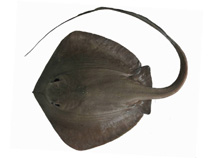
Klassifizierung / Names
Namen | Synonyme | Catalog of Fishes(Gattung, Arten) | ITIS | CoL | WoRMS | Cloffa
Elasmobranchii (Haie und Rochen) (sharks and rays) >
Myliobatiformes (Stingrays) >
Dasyatidae (Stingrays) > Hypolophinae
Etymology: Pastinachus: Latin, pastinaca = a sting ray (Ref. 45335); stellurostris: Name for Greek 'stella' for starry and Latin 'rostrum' for snout; referring to the characteristic star-shaped denticles on the snout.
More on authors: Last, Fahmi & Naylor.
Umwelt: Milieu / Klimazone / Tiefenbereich / Verbreitungsgebiet
Ökologie
; süßwasser; brackwasser demersal. Tropical
Asia: Indonesia. Known from West Kalimantan in the vicinity of the Kapuas River estuary and near Pemangkat. Possibly misidentified locally as another species of Pastinachus and may be more widely distributed in parts of Borneo, and even Sumatra, where the habitat is suitable. A juvenile male (MTUF P 30003), collected about 60 km upstream from the mouth of the Bang Pakong River in Thailand, may represent the first record of this species outside Borneo.
Größe / Gewicht / Alter
Geschlechtsreife: Lm ? range ? - ? cm
Max length : 42.8 cm WD Männchen/unbestimmt; (Ref. 84289)
This species probably prefers shallow, fresh or brackish water habitats (Ref. 84289).
Lebenszyklus und Paarungsverhalten
Geschlechtsreife | Fortpflanzung | Ablaichen | Eier | Fruchtbarkeit | Larven
Last, P.R., Fahmi and G.J.P. Naylor, 2010. Pastinachus stellurostris sp. nov., a new stingray (Elasmobranchii: Myliobatiformes) from Indonesian Borneo. pp. 129-140. In Last, P.R., White, W.T. & Pogonoski, J.J. (eds.): Descriptions of new sharks and rays from Borneo. CSIRO Marine and Atmospheric Research Paper no. 32. (Ref. 84289)
IUCN Rote Liste Status (Ref. 130435: Version 2025-2 (Global))
Bedrohung für Menschen
Harmless
Nutzung durch Menschen
Tools
Zusatzinformationen
Download XML
Internet Quellen
Schätzungen auf der Grundlage von Modellen
Phylogenetischer Diversitätsindex (Ref.
82804): PD
50 = 0.5312 [Uniqueness, from 0.5 = low to 2.0 = high].
Bayesian length-weight: a=0.01000 (0.00244 - 0.04107), b=3.04 (2.81 - 3.27), in cm total length, based on all LWR estimates for this body shape (Ref.
93245).
Trophische Ebene (Ref.
69278): 3.7 ±0.6 se; based on size and trophs of closest relatives
Anfälligkeit der Fischerei (Ref.
59153): Very high vulnerability (90 of 100).
🛈