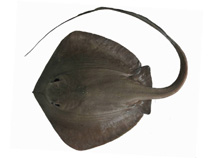
Elasmobranquios (tiburones y rayas) (sharks and rays) >
Myliobatiformes (Stingrays) >
Dasyatidae (Stingrays) > Hypolophinae
Etymology: Pastinachus: Latin, pastinaca = a sting ray (Ref. 45335); stellurostris: Name for Greek 'stella' for starry and Latin 'rostrum' for snout; referring to the characteristic star-shaped denticles on the snout.
More on authors: Last, Fahmi & Naylor.
Entorno: milieu / zona climática / rango de profundidad / gama de distribución
Ecología
; agua dulce; salobre demersal. Tropical
Asia: Indonesia. Known from West Kalimantan in the vicinity of the Kapuas River estuary and near Pemangkat. Possibly misidentified locally as another species of Pastinachus and may be more widely distributed in parts of Borneo, and even Sumatra, where the habitat is suitable. A juvenile male (MTUF P 30003), collected about 60 km upstream from the mouth of the Bang Pakong River in Thailand, may represent the first record of this species outside Borneo.
Tamaño / Peso / Edad
Madurez: Lm ? range ? - ? cm
Max length : 42.8 cm WD macho / no sexado; (Ref. 84289)
This species probably prefers shallow, fresh or brackish water habitats (Ref. 84289).
Ciclo vital y comportamiento de apareamiento
Madurez | Reproducción | Puesta | Huevos | Fecundidad | Larva
Last, P.R., Fahmi and G.J.P. Naylor, 2010. Pastinachus stellurostris sp. nov., a new stingray (Elasmobranchii: Myliobatiformes) from Indonesian Borneo. pp. 129-140. In Last, P.R., White, W.T. & Pogonoski, J.J. (eds.): Descriptions of new sharks and rays from Borneo. CSIRO Marine and Atmospheric Research Paper no. 32. (Ref. 84289)
Situación en la Lista Roja de la UICN (Ref. 130435: Version 2025-2 (Global))
Amenaza para el ser humano
Harmless
Usos humanos
Herramientas
Informes especiales
Descargar XML
Fuentes de Internet
Estimaciones basadas en modelos
Índice de diversidad filogenética (Referencia
82804): PD
50 = 0.5312 [Uniqueness, from 0.5 = low to 2.0 = high].
Bayesian length-weight: a=0.01000 (0.00244 - 0.04107), b=3.04 (2.81 - 3.27), in cm total length, based on all LWR estimates for this body shape (Ref.
93245).
Nivel trófico (Referencia
69278): 3.7 ±0.6 se; based on size and trophs of closest relatives
Vulnerabilidad pesquera (Ref.
59153): Very high vulnerability (90 of 100).
🛈