klasifikasi / Nama
Nama-nama umum | Sinonim (persamaan) | Catalog of Fishes(Marga, Jenis) | ITIS | CoL | WoRMS | Cloffa
>
Cichliformes (Cichlids, convict blennies) >
Cichlidae (Cichlids) > Pseudocrenilabrinae
Etymology: Maylandia: In honour of Hans J. Mayland, German ictiologist (Ref. 45335); mossambica: The specific epithet, mossambicus, refers to the area where the species is native; an adjective (Ref. 86409).
Eponymy: Hans-Joachim Mayland (1928–2004) was a German ichthyologist, aquarist, photographer and writer. [...] (Ref. 128868), visit book page.
Lingkungan: lingkungan / zona iklim / kisaran kedalaman / jangkauan distribusi
Ekologi
; air tawar bentopelagis. Tropical; 13°S - 14°S, 34°E - 35°E
Africa: Lake Malawi in Mozambique (Ref. 86490).
Ukuran / Berat / umur
Kematangan: Lm ? range ? - ? cm
Max length : 8.0 cm SL jantan/; (Ref. 86409)
deskripsi pendek
Kunci identifiaksi (pengenalan) | Morfologi | Morfometrik
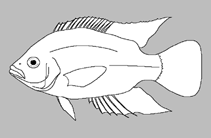
Duri punggung (Keseluruhan (total)) : 16 - 18; duri punggung lunak (Keseluruhan (total)) : 8 - 10; Duri dubur: 3; Sirip dubur lunak: 7 - 9. Diagnosis: A moderately-sloped head and bicuspid teeth in the outer row of the jaws place this species in Maylandia (Ref. 86409). Male M. mossambica from Chiloelo are distinguished from those of all other members of Maylandia by the absence of a black submarginal band in the dorsal and by black streaks in the caudal and in the posterior portion of the dorsal fin; male M. mossambica from Chinuni are distinguished from those of all other Maylandia by the absence of a black submarginal band in the dorsal and by a narrow black submarginal band in the anal fin; male M. mossambica from Lumessi are distinguished from all other Maylandia, except M. aurora, M. chrysomallos, and M. xanthos by the absence of a black submarginal band in the dorsal, a yellow ventral half of the head, breast, and dorsal fin, and a light-blue nape; male M. mossambica from Lumessi population differ from those of M. chrysomallos by a yellow dorsal fin which is light-blue in the latter (Ref. 86409). Maylandia mossambica differs from M. aurora by more vertical bars below the dorsal, 7–9 vs. 6, and from M. xanthos by a shorter lower jaw, 27.9–33.8% of head length vs. 34.6–36.7% (Ref. 86409). Based on the colour pattern, female M. mossambica cannot reliably be distinguished from those of most other members of the Aurora group but have 7 or 8 bars below the dorsal fin vs. 6 bars in M. aurora (Ref. 86409).
Body shape (shape guide): fusiform / normal.
Siklus hidup dan perilaku kawin
Kematangan | Reproduksi, perkembang biakan | Pemijahan | telur-telur | Fekunditas | Larva
Ciccotto, P.J., A. Konings and J.R. Stauffer Jr., 2011. Descriptions of five new species in the genus Metriaclima (Teleostei: Cichlidae) from Lake Malaŵi, Africa. Zootaxa 2738:1-25. (Ref. 86409)
Status IUCN Red List (Ref. 130435: Version 2025-2 (Global))
ancaman kepada manusia
Harmless
penggunaan manusia
Alat, peralatan
laporan khas
muat turun XML
Sumber internet
Estimasi berdasarkan model
Indeks keanekaragaman filogenetik (Acuan
82804): PD
50 = 0.5000 [Uniqueness, from 0.5 = low to 2.0 = high].
Bayesian length-weight: a=0.01445 (0.00671 - 0.03113), b=2.99 (2.82 - 3.16), in cm total length, based on LWR estimates for this (Sub)family-body shape (Ref.
93245).
Tingkat Trofik (Acuan
69278): 2.3 ±0.1 se; based on size and trophs of closest relatives
Kerentanan Penangkapan Ikan (Ref.
59153): Low vulnerability (10 of 100).
🛈