klasifikasi / Nama
Nama-nama umum | Sinonim (persamaan) | Catalog of Fishes(Marga, Jenis) | ITIS | CoL | WoRMS | Cloffa
>
Cyprinodontiformes (Rivulines, killifishes and live bearers) >
Rivulidae (Rivulines) > Cynolebiinae
Etymology: quirogai: Named for Horacio Quiroga, an Uruguayan writer from the early 20th century, whose tales and fables based on his life in the Misiones rainforest inspired the authors to explore nature and its mysteries. Specific epithet is used as a patronym.
Eponymy: Horacio Quiroga (1878–1937) was a Uruguayan writer whose “…tales and fables based on his life in the Misiones rainforest inspired the authors to explore nature and its mysteries. [...] (Ref. 128868), visit book page.
Lingkungan: lingkungan / zona iklim / kisaran kedalaman / jangkauan distribusi
Ekologi
; air tawar bentopelagis. Subtropical
South America: temporary ponds from the middle to the upper and eastern río Negro tributaries (río Uruguay basin), and río Yaguarón (Laguna Merín basin) in Uruguay.
Ukuran / Berat / umur
Kematangan: Lm ? range ? - ? cm
Max length : 4.8 cm SL jantan/; (Ref. 87318)
deskripsi pendek
Kunci identifiaksi (pengenalan) | Morfologi | Morfometrik
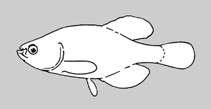
vertebrata, bertulang belakang: 28 - 31. Diagnosed from all its congeners by having a unique pigmentation pattern of body and fins in males consisting of a uniform bluish gray background color on the body that lacks vertical bands, and uniform pigmentation of unpaired fins. Can also be distinguished by the combination of characters associated with reduced squamation in the abdominal, preopercular, and opercular regions. The reduction in the number of scales in the abdomen occurs in three alternative states: completely naked abdomen, only a ventral row of small scales, or just area below pectoral fin without scales (vs. scales always absent in anterior part of the abdomen as in Austrolebias gymnoventris); preopercular region is either completely naked or only has a few scales present in its center (vs. preopercular region always naked as in Austrolebias gymnoventris); and the opercular region is from completely naked to only distal edge naked (vs. only opercular distal edge naked as in Austrolebias gymnoventris). However, in extremely large males (SL > 40 mm) and females (SL > 34 mm), which represent less than 7% of individuals analyzed, scales almost completely cover the preopercular, opercular, and abdominal regions (Ref. 87318).
Body shape (shape guide): elongated.
Siklus hidup dan perilaku kawin
Kematangan | Reproduksi, perkembang biakan | Pemijahan | telur-telur | Fekunditas | Larva
Loureiro, M., A. Duarte and M. Zarucki, 2011. A new species of Austrolebias Costa (Cyprinodontiformes: Rivulidae) from northeastern Uruguay, with comments on distribution patterns. Neotrop. Ichthyol. 9(2):335-342. (Ref. 87318)
Status IUCN Red List (Ref. 130435: Version 2025-2 (Global))
ancaman kepada manusia
Harmless
penggunaan manusia
Perikanan: tidak ada kepentingan
Alat, peralatan
laporan khas
muat turun XML
Sumber internet
Estimasi berdasarkan model
Indeks keanekaragaman filogenetik (Acuan
82804): PD
50 = 0.7500 [Uniqueness, from 0.5 = low to 2.0 = high].
Bayesian length-weight: a=0.00617 (0.00266 - 0.01427), b=3.13 (2.93 - 3.33), in cm total length, based on LWR estimates for this (Sub)family-body shape (Ref.
93245).
Tingkat Trofik (Acuan
69278): 3.2 ±0.4 se; based on size and trophs of closest relatives
Daya lenting (Acuan
120179): Tinggi, Waktu penggandaan populasi minimum kurang dari 15 bulan (Preliminary K or Fecundity.).
Kerentanan Penangkapan Ikan (Ref.
59153): Low vulnerability (10 of 100).
🛈