Klassifizierung / Names
Namen | Synonyme | Catalog of Fishes(Gattung, Arten) | ITIS | CoL | WoRMS | Cloffa
>
Cyprinodontiformes (Rivulines, killifishes and live bearers) >
Rivulidae (Rivulines) > Cynolebiinae
Etymology: quirogai: Named for Horacio Quiroga, an Uruguayan writer from the early 20th century, whose tales and fables based on his life in the Misiones rainforest inspired the authors to explore nature and its mysteries. Specific epithet is used as a patronym.
Eponymy: Horacio Quiroga (1878–1937) was a Uruguayan writer whose “…tales and fables based on his life in the Misiones rainforest inspired the authors to explore nature and its mysteries. [...] (Ref. 128868), visit book page.
Umwelt: Milieu / Klimazone / Tiefenbereich / Verbreitungsgebiet
Ökologie
; süßwasser benthopelagisch. Subtropical
South America: temporary ponds from the middle to the upper and eastern río Negro tributaries (río Uruguay basin), and río Yaguarón (Laguna Merín basin) in Uruguay.
Größe / Gewicht / Alter
Geschlechtsreife: Lm ? range ? - ? cm
Max length : 4.8 cm SL Männchen/unbestimmt; (Ref. 87318)
Kurzbeschreibung
Bestimmungsschlüssel | Morphologie | Morphometrie
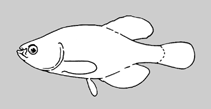
Wirbelzahl: 28 - 31. Diagnosed from all its congeners by having a unique pigmentation pattern of body and fins in males consisting of a uniform bluish gray background color on the body that lacks vertical bands, and uniform pigmentation of unpaired fins. Can also be distinguished by the combination of characters associated with reduced squamation in the abdominal, preopercular, and opercular regions. The reduction in the number of scales in the abdomen occurs in three alternative states: completely naked abdomen, only a ventral row of small scales, or just area below pectoral fin without scales (vs. scales always absent in anterior part of the abdomen as in Austrolebias gymnoventris); preopercular region is either completely naked or only has a few scales present in its center (vs. preopercular region always naked as in Austrolebias gymnoventris); and the opercular region is from completely naked to only distal edge naked (vs. only opercular distal edge naked as in Austrolebias gymnoventris). However, in extremely large males (SL > 40 mm) and females (SL > 34 mm), which represent less than 7% of individuals analyzed, scales almost completely cover the preopercular, opercular, and abdominal regions (Ref. 87318).
Body shape (shape guide): elongated.
Lebenszyklus und Paarungsverhalten
Geschlechtsreife | Fortpflanzung | Ablaichen | Eier | Fruchtbarkeit | Larven
Loureiro, M., A. Duarte and M. Zarucki, 2011. A new species of Austrolebias Costa (Cyprinodontiformes: Rivulidae) from northeastern Uruguay, with comments on distribution patterns. Neotrop. Ichthyol. 9(2):335-342. (Ref. 87318)
IUCN Rote Liste Status (Ref. 130435: Version 2025-2 (Global))
Bedrohung für Menschen
Harmless
Nutzung durch Menschen
Fischereien: nicht kommerziell
Tools
Zusatzinformationen
Download XML
Internet Quellen
Schätzungen auf der Grundlage von Modellen
Phylogenetischer Diversitätsindex (Ref.
82804): PD
50 = 0.7500 [Uniqueness, from 0.5 = low to 2.0 = high].
Bayesian length-weight: a=0.00617 (0.00266 - 0.01427), b=3.13 (2.93 - 3.33), in cm total length, based on LWR estimates for this (Sub)family-body shape (Ref.
93245).
Trophische Ebene (Ref.
69278): 3.2 ±0.4 se; based on size and trophs of closest relatives
Widerstandsfähigkeit (Ref.
120179): hoch, Verdopplung der Population dauert weniger als 15 Monate. (Preliminary K or Fecundity.).
Anfälligkeit der Fischerei (Ref.
59153): Low vulnerability (10 of 100).
🛈