klasifikasi / Nama
Nama-nama umum | Sinonim (persamaan) | Catalog of Fishes(Marga, Jenis) | ITIS | CoL | WoRMS | Cloffa
>
Cyprinodontiformes (Rivulines, killifishes and live bearers) >
Rivulidae (Rivulines) > Cynolebiinae
Etymology: guanambi: Named after the city of Guanambi, around which vast plain areas flooded by the Caunaúba de Dentro River drainage are inhabited by five endemic annual fish species, including Hypsolebias guanambi, thus constituting an important area of endemism for the Rivulidae. The specific name is derived from the Tupi-Guarani, meaning hummingbird.
More on authors: Costa & Amorim.
Lingkungan: lingkungan / zona iklim / kisaran kedalaman / jangkauan distribusi
Ekologi
; air tawar bentopelagis. Tropical
South America: known only from seasonal pools associated to São Francisco River in Bahia, Brazil.
Ukuran / Berat / umur
Kematangan: Lm ? range ? - ? cm
Max length : 3.9 cm SL jantan/; (Ref. 87364)
deskripsi pendek
Kunci identifiaksi (pengenalan) | Morfologi | Morfometrik
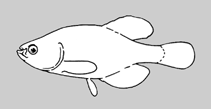
Distinguished from all members of the Hypsolebias flavicaudatus species complex, except H. nitens, by having the dorsal and anal fins with short filamentous rays, the tip of the filaments reaching between the basal and middle portion of the caudal fin (vs. reaching the posterior portion of the caudal fin or surpassing its posterior edge). Can be diagnosed from all species of the complex, except H. flavicaudatus and H. gilbertobrasili, by the presence of bluish white dots on the antero-basal portion of the dorsal fin in males; from H. nitens in possessing body depth 35.8-39.5% SL. Differs from H. nitens and H. flavicaudatus by having the largest spot on the middle part of the flank in females larger than pupil (vs. smaller), caudal peduncle more slender (caudal peduncle depth 13.1-14.7% SL vs. 15.5-17.3% SL); from H. flagellatus, H. gilbertobrasili, H. janaubensis and H. radiseriatus by having the second proximal radial of the dorsal fin inmales between the neural spines of vertebrae 8 and 9 (vs. between the neural spines of vertebrae 6 and 8); from H. gilbertobrasili and H. flavicaudatus in having more dark grey bars on the flank in males (11-14 vs. 8-10). Possesses only 4-6 teeth on the second pharyngobranchial bone, contrasting to 7-11 in all other species of the complex (Ref. 89836).
Body shape (shape guide): short and / or deep.
Inhabits seasonal pools. Sympatric with Hypsolebias carlettoi. Presently confined to a small, disturbed area with extent of occurrence of about 0.05 km2 and area of occupancy about 0.003 square km (Ref. 89836).
Siklus hidup dan perilaku kawin
Kematangan | Reproduksi, perkembang biakan | Pemijahan | telur-telur | Fekunditas | Larva
Costa, W.J.E.M. and P.F. Amorim, 2011. A new annual killifish species of the Hypsolebias flavicaudatus complex from the São Francisco River basin, Brazilian Caatinga (Cyprinodontiformes: Rivulidae). Vertebr. Zool. 61(1):99-104. (Ref. 87364)
Status IUCN Red List (Ref. 130435: Version 2025-2 (Global))
ancaman kepada manusia
Harmless
penggunaan manusia
Alat, peralatan
laporan khas
muat turun XML
Sumber internet
Estimasi berdasarkan model
Indeks keanekaragaman filogenetik (Acuan
82804): PD
50 = 0.5000 [Uniqueness, from 0.5 = low to 2.0 = high].
Bayesian length-weight: a=0.01995 (0.00906 - 0.04395), b=3.01 (2.83 - 3.19), in cm total length, based on all LWR estimates for this body shape (Ref.
93245).
Tingkat Trofik (Acuan
69278): 3.2 ±0.4 se; based on size and trophs of closest relatives
Kerentanan Penangkapan Ikan (Ref.
59153): Low vulnerability (10 of 100).
🛈