Classificazione / Nomi
Nomi Comuni | Sinonimi | Catalog of Fishes(Genere, Specie) | ITIS | CoL | WoRMS | Cloffa
>
Cyprinodontiformes (Rivulines, killifishes and live bearers) >
Rivulidae (Rivulines) > Cynolebiinae
Etymology: guanambi: Named after the city of Guanambi, around which vast plain areas flooded by the Caunaúba de Dentro River drainage are inhabited by five endemic annual fish species, including Hypsolebias guanambi, thus constituting an important area of endemism for the Rivulidae. The specific name is derived from the Tupi-Guarani, meaning hummingbird.
More on authors: Costa & Amorim.
Ambiente: milieu / zona climatica / distribuzione batimetrica / gamma di distribuzione
Ecologia
; acqua dolce benthopelagico. Tropical
South America: known only from seasonal pools associated to São Francisco River in Bahia, Brazil.
Dimensione / Peso / Età
Maturità: Lm ? range ? - ? cm
Max length : 3.9 cm SL maschio/sesso non determinato; (Ref. 87364)
Breve descrizione
Chiavi di identificazione | Morfologia | Morfometria
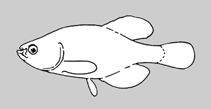
Distinguished from all members of the Hypsolebias flavicaudatus species complex, except H. nitens, by having the dorsal and anal fins with short filamentous rays, the tip of the filaments reaching between the basal and middle portion of the caudal fin (vs. reaching the posterior portion of the caudal fin or surpassing its posterior edge). Can be diagnosed from all species of the complex, except H. flavicaudatus and H. gilbertobrasili, by the presence of bluish white dots on the antero-basal portion of the dorsal fin in males; from H. nitens in possessing body depth 35.8-39.5% SL. Differs from H. nitens and H. flavicaudatus by having the largest spot on the middle part of the flank in females larger than pupil (vs. smaller), caudal peduncle more slender (caudal peduncle depth 13.1-14.7% SL vs. 15.5-17.3% SL); from H. flagellatus, H. gilbertobrasili, H. janaubensis and H. radiseriatus by having the second proximal radial of the dorsal fin inmales between the neural spines of vertebrae 8 and 9 (vs. between the neural spines of vertebrae 6 and 8); from H. gilbertobrasili and H. flavicaudatus in having more dark grey bars on the flank in males (11-14 vs. 8-10). Possesses only 4-6 teeth on the second pharyngobranchial bone, contrasting to 7-11 in all other species of the complex (Ref. 89836).
Body shape (shape guide): short and / or deep.
Inhabits seasonal pools. Sympatric with Hypsolebias carlettoi. Presently confined to a small, disturbed area with extent of occurrence of about 0.05 km2 and area of occupancy about 0.003 square km (Ref. 89836).
Ciclo vitale e comportamento di accoppiamento
Maturità | Riproduzione | Deposizione | Uova | Fecondità | Larve
Costa, W.J.E.M. and P.F. Amorim, 2011. A new annual killifish species of the Hypsolebias flavicaudatus complex from the São Francisco River basin, Brazilian Caatinga (Cyprinodontiformes: Rivulidae). Vertebr. Zool. 61(1):99-104. (Ref. 87364)
Stato della Lista Rossa IUCN (Ref. 130435: Version 2025-2 (Global))
Minaccia per l'uomo
Harmless
Usi umani
Strumenti
Rapporti speciali
Scarica XML
Fonti Internet
Stime basate su modelli
Indice di diversità filogenetica (Fonte Biblio.
82804): PD
50 = 0.5000 [Uniqueness, from 0.5 = low to 2.0 = high].
Bayesian length-weight: a=0.01995 (0.00906 - 0.04395), b=3.01 (2.83 - 3.19), in cm total length, based on all LWR estimates for this body shape (Ref.
93245).
Livello trofico (Fonte Biblio.
69278): 3.2 ±0.4 se; based on size and trophs of closest relatives
Vulnerabilità della pesca (Ref.
59153): Low vulnerability (10 of 100).
🛈