Elasmobranchi (squali e razze) (sharks and rays) >
Squaliformes (Sleeper and dogfish sharks) >
Etmopteridae (Lantern sharks)
Etymology: Etmopterus: Greek, ethmos, -ou = sieve or ethmoides bone + Greek, pteron = wing, fin (Ref. 45335); viator: The species is named after the Latin word viator (the traveler), since the species is confirmed for geographically distant locations in the Southern Hemisphere (Ref. 87779).
Ambiente: milieu / zona climatica / distribuzione batimetrica / gamma di distribuzione
Ecologia
marino batidemersale; distribuzione batimetrica 830 - 1400 m (Ref. 87779). Deep-water
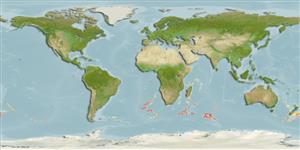
Southern Ocean: Northern part of the Kerguelen Plateau, off New Zealand and South Africa. Further confirmed for the Macquarie Ridge (P. Last, pers. comm.). It hypothetically occurs in the whole Southern Hemisphere (Ref. 87779).
Lunghezza alla prima maturità / Dimensione / Peso / Età
Maturità: Lm 48.0, range 46 - 50 cm
Max length : 39.1 cm TL maschio/sesso non determinato; (Ref. 87779); 57.7 cm TL (female)
Breve descrizione
Chiavi di identificazione | Morfologia | Morfometria
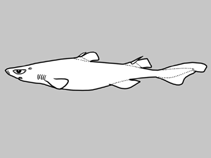
Vertebre: 75 - 84. A medium-sized Etmopterus species with the following combination of characters: body fusiform, caudal peduncle short 0.1 (0.09-0.1) % of total length (TL). Moderately long interdorsal distance 0.19 (0.17-0.24) % TL, very long distance from first dorsal fin spine insertion to snout tip 0.36 (0.36-0.43)% TL. Head long 0.21 (0.21-0.26) % TL and broad 0.1 (0.1-0.15) % TL long, as long as caudal peduncle. Snout short 0.41 (0.40-0.46) % head length (HL) and broad 0.37 (0.34-0.38) % HL. Interorbital distance narrow 0.28 (0.26-0.36) % HL, shorter than snout width. Large oval eyes, eye length 0.26 (0.19-0.26) % HL. Eyes reflect greenish in fresh specimens. Large tear-drop shaped spiracles 0.05 (0.03-0.08) % HL. Mouth strongly arched and broad 0.4 (0.11-0.43) % HL with dignathic homodont dentition . Nostrils large and oblique 0.11 (0.11-0.15) % HL. Gill openings with distinct white margins. Pectoral fins rounded and white-edged with fringed ceratotrichia, moderate in size. Inner margin 0.04 (0.04-0.06) % TL, fin base short 0.05 (0.03-0.06) % TL. Dorsal fins densely covered with dermal denticles, 2nd dorsal fin significantly larger than 1st dorsal fin, height 0.09 (0.10-0.15) % TL compared to 0.03 (0.03-0.05) % TL in 1st dorsal fin. 2nd dorsal fin deeply concave with drawn-out lower lobe. Both dorsal fins fringed, with strong fin spines. The 2nd dorsal fin spine is larger than 1st (broken in the holotype) pointing posteriorly. First dorsal fin originate distinctively behind the pectoral fin insertions, whereas origin of 2nd dorsal fin only sligthly behind pelvic fin insertions. Large heterocercal caudal fin 0.2 (0.19-0.21) % TL with strong upper and weaker lower edged lobes, widely covered with dermal denticles (Ref. 87779).
Body shape (shape guide): elongated.
Ciclo vitale e comportamento di accoppiamento
Maturità | Riproduzione | Deposizione | Uova | Fecondità | Larve
E. viator is ovoviviparous and gives birth to 2-10 pups per litter. Maturity is reached at approximately 50 cm TL in females and 46 cm TL in males (Duhamel et al., 2005). Males are on average smaller than females, adult females reach at least 58 cm TL, adult males approximately 50 cm TL (Ref. 87779).
Straube, N., G. Duhamel, N. Gasco, J. Kriwet and U.K. Schliewen, 2011. Description of a new deep-sea Lantern Shark Etmopterus viator sp. nov. (Squaliformes: Etmopteridae) from the Southern Hemisphere. The Kerguelen Plateau: marine ecosystem and fisheries. Société Française d'Ichtyologie, Paris, France. Guy Duhamel and Dirk Welsford, Eds. (Ref. 87779)
Stato della Lista Rossa IUCN (Ref. 130435: Version 2025-2 (Global))
Minaccia per l'uomo
Harmless
Usi umani
Pesca: di nessun interesse
Strumenti
Rapporti speciali
Scarica XML
Fonti Internet
Stime basate su modelli
Temperatura preferita (Fonte Biblio.
123201): 2.1 - 2.2, mean 2.1 °C (based on 6 cells).
Indice di diversità filogenetica (Fonte Biblio.
82804): PD
50 = 0.5000 [Uniqueness, from 0.5 = low to 2.0 = high].
Bayesian length-weight: a=0.00389 (0.00200 - 0.00755), b=3.08 (2.91 - 3.25), in cm total length, based on LWR estimates for this Genus-body shape (Ref.
93245).
Livello trofico (Fonte Biblio.
69278): 4.3 ±0.6 se; based on size and trophs of closest relatives
Resilienza (Fonte Biblio.
120179): Basso, tempo minimo di raddoppiamento della popolazione 4.5 - 14 anni (Preliminary K or Fecundity.).
Vulnerabilità della pesca (Ref.
59153): Moderate vulnerability (43 of 100).
🛈