分類 / 名前
共通名の | 類義語 | Catalog of Fishes(部類, 種) | ITIS | CoL | WoRMS | Cloffa
板鰓亜鋼(サメとエイ類) (sharks and rays) >
Squaliformes (Sleeper and dogfish sharks) >
Etmopteridae (Lantern sharks)
Etymology: Etmopterus: Greek, ethmos, -ou = sieve or ethmoides bone + Greek, pteron = wing, fin (Ref. 45335); viator: The species is named after the Latin word viator (the traveler), since the species is confirmed for geographically distant locations in the Southern Hemisphere (Ref. 87779).
環境:環境 / 気候帯 / 深さの範囲 / 分布範囲
生態学
海 深海魚; 深さの範囲 830 - 1400 m (Ref. 87779). Deep-water
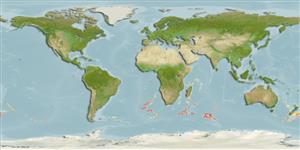
Southern Ocean: Northern part of the Kerguelen Plateau, off New Zealand and South Africa. Further confirmed for the Macquarie Ridge (P. Last, pers. comm.). It hypothetically occurs in the whole Southern Hemisphere (Ref. 87779).
初回成熟時の長さ / サイズ / 重さ / 年齢
成熟: Lm 48.0, range 46 - 50 cm
Max length : 39.1 cm TL オス/雌雄の選別がない; (Ref. 87779); 57.7 cm TL (female)
簡単な記述
検索表 | 形態学 | 形態計測学
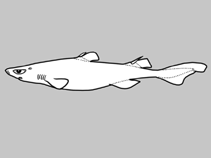
脊つい: 75 - 84. A medium-sized Etmopterus species with the following combination of characters: body fusiform, caudal peduncle short 0.1 (0.09-0.1) % of total length (TL). Moderately long interdorsal distance 0.19 (0.17-0.24) % TL, very long distance from first dorsal fin spine insertion to snout tip 0.36 (0.36-0.43)% TL. Head long 0.21 (0.21-0.26) % TL and broad 0.1 (0.1-0.15) % TL long, as long as caudal peduncle. Snout short 0.41 (0.40-0.46) % head length (HL) and broad 0.37 (0.34-0.38) % HL. Interorbital distance narrow 0.28 (0.26-0.36) % HL, shorter than snout width. Large oval eyes, eye length 0.26 (0.19-0.26) % HL. Eyes reflect greenish in fresh specimens. Large tear-drop shaped spiracles 0.05 (0.03-0.08) % HL. Mouth strongly arched and broad 0.4 (0.11-0.43) % HL with dignathic homodont dentition . Nostrils large and oblique 0.11 (0.11-0.15) % HL. Gill openings with distinct white margins. Pectoral fins rounded and white-edged with fringed ceratotrichia, moderate in size. Inner margin 0.04 (0.04-0.06) % TL, fin base short 0.05 (0.03-0.06) % TL. Dorsal fins densely covered with dermal denticles, 2nd dorsal fin significantly larger than 1st dorsal fin, height 0.09 (0.10-0.15) % TL compared to 0.03 (0.03-0.05) % TL in 1st dorsal fin. 2nd dorsal fin deeply concave with drawn-out lower lobe. Both dorsal fins fringed, with strong fin spines. The 2nd dorsal fin spine is larger than 1st (broken in the holotype) pointing posteriorly. First dorsal fin originate distinctively behind the pectoral fin insertions, whereas origin of 2nd dorsal fin only sligthly behind pelvic fin insertions. Large heterocercal caudal fin 0.2 (0.19-0.21) % TL with strong upper and weaker lower edged lobes, widely covered with dermal denticles (Ref. 87779).
Body shape (shape guide): elongated.
ライフサイクルと交尾行動
成熟 | 繁殖 | 放精 | 卵 | 生産力 | 幼生
E. viator is ovoviviparous and gives birth to 2-10 pups per litter. Maturity is reached at approximately 50 cm TL in females and 46 cm TL in males (Duhamel et al., 2005). Males are on average smaller than females, adult females reach at least 58 cm TL, adult males approximately 50 cm TL (Ref. 87779).
Straube, N., G. Duhamel, N. Gasco, J. Kriwet and U.K. Schliewen, 2011. Description of a new deep-sea Lantern Shark Etmopterus viator sp. nov. (Squaliformes: Etmopteridae) from the Southern Hemisphere. The Kerguelen Plateau: marine ecosystem and fisheries. Société Française d'Ichtyologie, Paris, France. Guy Duhamel and Dirk Welsford, Eds. (Ref. 87779)
IUCNのレッドリストの状況は (Ref. 130435: Version 2025-2 (Global))
人間の用途
水産業: 興味がない
用具
特記事項
XMLをダウンロードして下さい
インターネットの情報源
モデルに基づく推定値
好ましい温度 (参照
123201): 2.1 - 2.2, mean 2.1 °C (based on 6 cells).
系統多様性指数 (参照
82804): PD
50 = 0.5000 [Uniqueness, from 0.5 = low to 2.0 = high].
Bayesian length-weight: a=0.00389 (0.00200 - 0.00755), b=3.08 (2.91 - 3.25), in cm total length, based on LWR estimates for this Genus-body shape (Ref.
93245).
栄養段階 (参照
69278): 4.3 ±0.6 se; based on size and trophs of closest relatives
回復力 (参照
120179): 低い, 4.5年~14年の倍増期間の最小個体群 (Preliminary K or Fecundity.).
漁業の脆弱性 (Ref.
59153): Moderate vulnerability (43 of 100).
🛈