การจำแนกประเภท / ชื่อ
ชื่อสามัญ | ชื่อพ้อง | Catalog of Fishes(สกุล, ชนิด) | ITIS | CoL | WoRMS | Cloffa
sub class Elasmobranchii (ฉลามและกระเบน) (sharks and rays) >
Squaliformes (Sleeper and dogfish sharks) >
Etmopteridae (Lantern sharks)
Etymology: Etmopterus: Greek, ethmos, -ou = sieve or ethmoides bone + Greek, pteron = wing, fin (Ref. 45335); sculptus: The species name derives from the Latin sculpo, in allusion to the carved or sculpted appearance of its linear denticles (Ref. 87957).
สิ่งแวดล้อม : สิ่งแวดล้อม / เขตภูมิอากาศ / ระดับความลึก / ระยะการกระจายสินค้า
นิเวศวิทยา
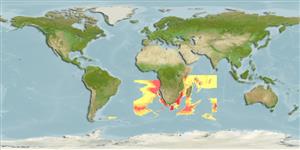
เกี่ยวกับทะเล,น้ำเค็ม สัตว์หน้าดินในเขตน้ำลึก; ระดับความลึก 240 - 1023 m (Ref. 106604). Deep-water
Southeast Atlantic and Southwest Indian Ocean: Namibia to southern Mozambique,
and Madagascar Ridge.
ความยาวเมื่อครบกำหนดครั้งแรก / ขนาด / น้ำหนัก / อายุ
วัยเจริญพันธุ์: Lm ?, range 42 - ? cm
Max length : 59.0 cm TL เพศผู้/กระเทย; (Ref. 106604); 51.5 cm TL (female)
คำอธิบายสั้นๆ
เครื่องมือที่ใช้ในการแยกชนิดสัตว์,สิ่งมีชีวิตออกจากกัน | สัณฐานวิทยา | ความยาวต่างๆ
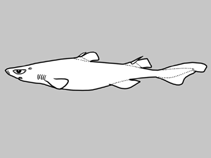
Etmopterus sculptus is a moderately large, stout, species of linear-denticled Etmopterus, which separates it from most other members of this genus, and can be distinguished from its three closest congeners within the E. Lucifer-group, E. brachyurus, E. lucifer, and E. molleri, by the length of its anterior flank markings being slightly longer than its posterior branch. The posterior branch of the flank markings on E. brachyurus and E. molleri are shorter relative to the anterior branch, and in E. lucifer, the anterior branch is nearly twice the length of the posterior branch. The new species can also be distinguished from its closest congeners by the arrangement of dermal denticles that extend over most of the upper and lower body surface. Etmopterus sculptus possesses non-overlapping denticles, giving it a rougher, more sculpted texture than these other aforementioned species. The arrangement of the dermal denticles onthe ventral head surface is also a good character for separating these species, with E. sculptus having uniformly distributed denticles while the ventral surface of E. Lucifer and E. molleri is sparsely covered with denticles. The ventral surface of the head of E. brachyurus typically lacks dermal denticles (Ref. 87957).
Body shape (shape guide): elongated.
This species is fairly common along the upper continental slopes between Namibia and southern Mozambique (Ref. 87957); upper slope, on or near the bottom (Ref. 5578). Observed mostly at depths between 450 and 900 m (Ref. 27644), but with records as shallow as 240 m (in Bass et al., 1976: listed as E. lucifer) (Ref. 87957). Feeds mainly on mid-water bony fish, also squid, octopus, shrimp and brittle stars (Ref. 5578).
วงจรชีวิตและพฤติกรรมการผสมพันธุ์
วัยเจริญพันธุ์ | การสืบพันธุ์ | การวางไข่ | เซลสืบพันธ์ของเพศเมีย(ไข่) | ความดกของไข่ | ตัวอ่อน
Bears 2 young (Ref. 5578). Distinct pairing with embrace (Ref. 205).
Ebert, D.A., Compagno, L.J.V. and M.J. De Vries, 2011. A New Lanternshark (Squaliformes: Etmopteridae: Etmopterus) from Southern Africa. Copeia 2011(3):379-384. (Ref. 87957)
สถานะบัญชีแดงของ IUCN (Ref. 130435: Version 2025-2 (Global))
ภัยคุกคามต่อมนุษย์
Harmless
การใช้ของมนุษย์
การประมง: ไม่มีผลประโยชน์
เครื่องมือ
รายงานพิเศษ
ดาวน์โหลด XML
แหล่งที่มาจากอินเตอร์เน็ต
การประมาณค่าตามแบบจำลอง
อุณหภูมิที่ต้องการ (อ้างอิง
123201): 1.9 - 8, mean 2.3 °C (based on 14 cells).
ดัชนีความหลากหลายทางวิวัฒนาการ (อ้างอิง
82804): PD
50 = 0.5000 [Uniqueness, from 0.5 = low to 2.0 = high].
Bayesian length-weight: a=0.00389 (0.00200 - 0.00755), b=3.08 (2.91 - 3.25), in cm total length, based on LWR estimates for this Genus-body shape (Ref.
93245).
ระดับชั้นอาหาร (อ้างอิง
69278): 4.3 ±0.6 se; based on size and trophs of closest relatives
ความสามารถในการกลับคืนสู่ปกติ (อ้างอิง
120179): ต่ำ, เวลาต่ำสุดที่จะทำให้ประชากรเพิ่มขึ้นเป็น 2 เท่าใช้เวลา 4.5 - 14 ปี (Deep-water species with low fecundity (RF)).
ความเสี่ยงต่อการตกปลา (Ref.
59153): Moderate vulnerability (44 of 100).
🛈