Classificazione / Nomi
Nomi Comuni | Sinonimi | Catalog of Fishes(Genere, Specie) | ITIS | CoL | WoRMS | Cloffa
>
Pleuronectiformes (Flatfishes) >
Cynoglossidae (Tonguefishes) > Symphurinae
Etymology: Symphurus: Greek, syn, symphysis = grown together + Greek, oura = tail (Ref. 45335); maculopinnis: The specific name, maculopinnis, from the Latin macula, meaning spot, and pinna, meaning fin, referring to the conspicuous spots on the dorsal and anal fins of this species; noun in apposition (Ref. 87974).
Ambiente: milieu / zona climatica / distribuzione batimetrica / gamma di distribuzione
Ecologia
marino benthopelagico; distribuzione batimetrica ? - 561 m (Ref. 87974). Tropical; 24°S - 25°S, 177°W - 178°W
Western Pacific: Tonga Arc, Volcano-19. Tunnicliffe et al., 2010 (Ref. 88005) indicated that this species was also observed at shallower depths (between 195-381 m) at a second, nearby site (Volcano-1). However, re-examination of photographs indicates that the individuals upon which these observations were based can not be positively identified. Thus, reported occurrences of S. maculopinnis both at Volcano-1 and at these shallower depths is tenuous (Ref. 87974).
Dimensione / Peso / Età
Maturità: Lm ? range ? - ? cm
Max length : 8.4 cm SL (female)
Breve descrizione
Chiavi di identificazione | Morfologia | Morfometria
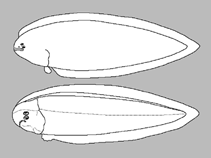
Symphurus maculopinnis is distinguished from all other species of Symphurus by the combination of a 1–2–2–2–1 ID pattern, 14 caudal-fin rays, 3+6 abdominal vertebrae, 49 total vertebrae, about 89 scales in a longitudinal row, 92 dorsal-fin rays, 77 anal-fin rays, a blunt squarish snout, blind-side lower jaw with thick lip with conspicuous plicae, and by conspicuous ocellated (sometimes partially) black spots on the posterior dorsal and anal fins (Ref. 87974).
Body shape (shape guide): fusiform / normal; Cross section: compressed.
Known only from the holotype, collected on soft sediments at 561 m; 56 other individuals observed, but not collected, were found on a variety of substrata, including coarse gravel, gravelly sand-shell and gravelly sand, located between 433-561 m on Volcano-19, Tonga Arc, western Pacific. Considered to be a true vent species since (Ref. 87974).
Ciclo vitale e comportamento di accoppiamento
Maturità | Riproduzione | Deposizione | Uova | Fecondità | Larve
Munroe, T.A., J. Tyler and V. Tunnicliffe, 2011. Description and biological observations on a new species of deepwater symphurine tonguefish (Pleuronectiformes: Cynoglossidae: Symphurus) collected at Volcano 19, Tonga Arc, West Pacific Ocean. Zootaxa 3061:53-66. (Ref. 87974)
Stato della Lista Rossa IUCN (Ref. 130435: Version 2025-2 (Global))
Minaccia per l'uomo
Harmless
Usi umani
Strumenti
Rapporti speciali
Scarica XML
Fonti Internet
Stime basate su modelli
Indice di diversità filogenetica (Fonte Biblio.
82804): PD
50 = 0.5000 [Uniqueness, from 0.5 = low to 2.0 = high].
Bayesian length-weight: a=0.01122 (0.00514 - 0.02450), b=3.04 (2.87 - 3.21), in cm total length, based on all LWR estimates for this body shape (Ref.
93245).
Livello trofico (Fonte Biblio.
69278): 3.2 ±0.4 se; based on size and trophs of closest relatives
Resilienza (Fonte Biblio.
120179): Alto, tempo minimo di raddoppiamento della popolazione meno di 15 mesi (Preliminary K or Fecundity.).
Vulnerabilità della pesca (Ref.
59153): Low vulnerability (10 of 100).
🛈