การจำแนกประเภท / ชื่อ
ชื่อสามัญ | ชื่อพ้อง | Catalog of Fishes(สกุล, ชนิด) | ITIS | CoL | WoRMS | Cloffa
>
Perciformes/Uranoscopoidei (Sand dwellers) >
Pinguipedidae (Sandperches)
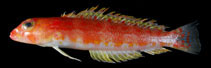
Etymology: Parapercis: Greek, para = the side of + Greek, perke = perch (Ref. 45335); rubromaculata: Name from Latin ruber for red, and maculate for spot, referring to the characteristic red spots on the caudal fin of this species when fresh (Ref. 89549).
สิ่งแวดล้อม : สิ่งแวดล้อม / เขตภูมิอากาศ / ระดับความลึก / ระยะการกระจายสินค้า
นิเวศวิทยา
เกี่ยวกับทะเล,น้ำเค็ม กลุ่มสัตว์หน้าดิน,กลุ่มสัตว์พื้นท้องน้ำ; ระดับความลึก 50 - 107 m (Ref. 117414). Tropical
Indo-West Pacific: Western Australia and Taiwan.
ขนาด / น้ำหนัก / อายุ
วัยเจริญพันธุ์: Lm ? range ? - ? cm
Max length : 11.4 cm SL เพศผู้/กระเทย; (Ref. 89549)
คำอธิบายสั้นๆ
เครื่องมือที่ใช้ในการแยกชนิดสัตว์,สิ่งมีชีวิตออกจากกัน | สัณฐานวิทยา | ความยาวต่างๆ
เงี่ยงครีบหลัง (รวม) : 5; ก้านครีบอ่อนที่หาง (รวม) : 20 - 21; เงี่ยงครีบก้น: 1; ก้านครีบอ่อนที่ก้น: 17; สัตว์มีกระดูกสันหลัง: 30. This species is distinguished by the following characters: D V,20–21 (usually 21) with fourth dorsal-fin spine longest; A I,17; pectoral-fin rays 16-18 (usually 17); lateral-line scales 51-53 (modally 52); gill rakers 4-6 + 8-11 = 12-16 (modally 14); predorsal cycloid scales 8-9, almost reaching vertical from hind margin of preopercle; cycloid scales on cheek, extending forward just beyond tip of maxilla, to vertical from anterior margin of pupil to middle of eye; canine teeth 6 in outer row at front of lower jaw; vomer with single row of 6-10 robust conical teeth; palatines no teeth; angle of subopercle is smooth, or with several minute serrae; vertebrae, abdominal 10, caudal 20; pelvic fin tip reaching from just posterior to vent to base of second anal-fin ray. Colouration: 5 broad poorly-defined reddish wedge-shaped saddles across sides; longitudinal series of large irregular yellowish blotches on lower sides from pec toral-fin base through base of saddles to caudal peduncle; soft dorsal fin with row of red spots along proximal quarter of fin, 6-7 of spots with black centres still visible in preservative; caudal fin with large irregular red blotches on its base, followed by smaller red blotches and scattered smaller red spots around centre and rear of fin (Ref. 117414).
Body shape (shape guide): elongated; Cross section: oval.
วงจรชีวิตและพฤติกรรมการผสมพันธุ์
วัยเจริญพันธุ์ | การสืบพันธุ์ | การวางไข่ | เซลสืบพันธ์ของเพศเมีย(ไข่) | ความดกของไข่ | ตัวอ่อน
Ho, H.-C., C.-H. Chang and K.-T. Shao, 2012. Two new sandperches (Perciformes: Pinguipedidae: Parapercis) from South China Sea, based on morphology and DNA barcoding. The Raffles Bulletin of Zoology 60(1):163-172. (Ref. 89549)
สถานะบัญชีแดงของ IUCN (Ref. 130435: Version 2025-2 (Global))
ภัยคุกคามต่อมนุษย์
Harmless
การใช้ของมนุษย์
เครื่องมือ
รายงานพิเศษ
ดาวน์โหลด XML
แหล่งที่มาจากอินเตอร์เน็ต
การประมาณค่าตามแบบจำลอง
ดัชนีความหลากหลายทางวิวัฒนาการ (อ้างอิง
82804): PD
50 = 0.5000 [Uniqueness, from 0.5 = low to 2.0 = high].
Bayesian length-weight: a=0.00692 (0.00314 - 0.01524), b=3.06 (2.88 - 3.24), in cm total length, based on LWR estimates for this Genus-body shape (Ref.
93245).
ระดับชั้นอาหาร (อ้างอิง
69278): 3.5 ±0.4 se; based on size and trophs of closest relatives
ความสามารถในการกลับคืนสู่ปกติ (อ้างอิง
120179): ความสูง, เวลาต่ำสุดที่จะทำให้ประชากรเพิ่มขึ้นเป็น 2 เท่าใช้เวลาน้อยกว่า 15 เดือน (Preliminary K or Fecundity.).
ความเสี่ยงต่อการตกปลา (Ref.
59153): Low vulnerability (10 of 100).
🛈