This website uses cookies to enhance your browsing experience and ensure the functionality of our site. For more detailed information about the types of cookies we use and how we protect your privacy, please visit our Privacy Information page.
×
Cookie Settings
This website uses different types of cookies to enhance your experience. Please select your preferences below:
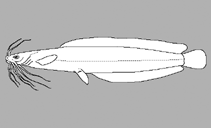
No image available for this species; drawing shows typical species in Clariidae.
分類 / 名前 共通名の | 類義語 | Catalog of Fishes(部類, 種) | ITIS | CoL | WoRMS | Cloffa
> Siluriformes (Catfishes) > Clariidae (Airbreathing catfishes)
Etymology: Tanganikallabes:Composed from lake Tanganyka + Greek, allabes, -etos = a fish of the Nile, a kind of lamprey (Ref. 45335); alboperca:The specific epithet, alboperca, is a combination of the latin adjective alba, meaning white, and the noun operculum, meaning lid or cover, a reference to the distinctive depigmented posterior margin seen in the operculum of this species (Ref. 90118).
背面の脊椎 (合計) : 0; 背鰭 (合計) : 65 - 74; 肛門の骨: 0; 臀鰭: 55 - 63. Diagnosis: Tanganikallabes alboperca is distinguished from all congeners by its relatively shorter pelvic fins, 6.0-7.7% of standard length vs. 7.1-9.3% in other Tanganikallabes species, which do not reach past the origin of the anal fin when adpressed, vs. reaching past the anal fin origin; it is also distinct from other Tanganikallabes species in the presence of a well-defined, depigmented border on the operculum, which extends from the upper margin of the operculum all the way to the union of the gill membranes at the isthmus, vs. border absent in Tanganikallabes mortiauxi and Tanganikallabes stewarti (Ref. 90118). Tanganikallabes alboperca is further distinguished from T. mortiauxi by its premaxillary toothpad shape, which is uniformly thin, broad crescent, vs. widest point anteroposteriorly thicker; io-iv and the suprapreopercle consisting of multiple separate elements, vs. a single element; the extensions of the lateral ethmoid not reaching io-ii when viewed from above, vs. nearly or completely overlying io-ii; its incomplete lateral line, vs. complete; shorter pectoral fin spine, 3.6-5.3% of standard length vs. 5.6-8.8%; generally lower number of dorsal fin rays, 65-74 vs. 72-81; smaller eye, 0.8-1.6% of standard length vs. 1.8-3.0%; and lack of a free lower orbital margin (Ref. 90118). Tanganikallabes alboperca is further separated from T. stewarti by having a relatively deeper body, body depth at anus 11.7-14.6% of standard length vs. 8.7-10.9%; longer lateral line; greater preanal length, 45.2-49.0% of standard length vs. 42.4-44.8%; and by generally having a lower number of anal fin rays, 55-63 vs. 63-69 (Ref. 90118).
Body shape (shape guide): elongated.
It is likely to inhabit rocky bottoms over a range of depths (Ref. 90118). Feeds on fish eggs, platythelphusid crab, and insect larvae (Ref. 90118).
Wright, J.J. and R.M. Bailey, 2012. Systematic revision of the formerly monotypic genus Tanganikallabes (Siluriformes: Clariidae). Zool. J. Linn. Soc. 165:121-142. (Ref. 90118)
IUCNのレッドリストの状況は (Ref. 130435: Version 2025-2 (Global))
系統多様性指数 (参照 82804): PD50 = 0.6250 [Uniqueness, from 0.5 = low to 2.0 = high].
Bayesian length-weight: a=0.00741 (0.00344 - 0.01597), b=2.97 (2.79 - 3.15), in cm total length, based on LWR estimates for this (Sub)family-body shape (Ref. 93245).
栄養段階 (参照 69278): 3.4 ±0.6 se; based on size and trophs of closest relatives
回復力 (参照 120179): 高い, 15か月以下の倍増期間の最小個体群 (Preliminary K or Fecundity.).
漁業の脆弱性 (Ref. 59153): Low vulnerability (10 of 100). 🛈