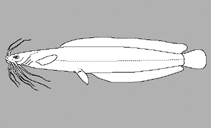
Классификация / Имена
народные названия | синонимы | Catalog of Fishes(род, виды) | ITIS | CoL | WoRMS | Cloffa
>
Siluriformes (Catfishes) >
Clariidae (Airbreathing catfishes)
Etymology: Tanganikallabes: Composed from lake Tanganyka + Greek, allabes, -etos = a fish of the Nile, a kind of lamprey (Ref. 45335); alboperca: The specific epithet, alboperca, is a combination of the latin adjective alba, meaning white, and the noun operculum, meaning lid or cover, a reference to the distinctive depigmented posterior margin seen in the operculum of this species (Ref. 90118).
Окружающая среда: среда / климатическая зона / пределы глубины / диапазон распространения
экология
; пресноводный донно-пелагический. Tropical
Africa: Lake Tanganyika (Ref. 90118).
Размер / Вес / Возраст
половая зрелость: Lm ? range ? - ? cm
Max length : 16.1 cm SL самец/пол неопределен; (Ref. 90118)
Краткое описание
определительные ключи | морфология | морфометрия
колючие лучи спинного плавника (общее число) : 0; членистые (мягкие) лучи спинного плавника (общее число) : 65 - 74; колючие лучи анального плавника: 0; членистые (мягкие) лучи анального плавника: 55 - 63. Diagnosis: Tanganikallabes alboperca is distinguished from all congeners by its relatively shorter pelvic fins, 6.0-7.7% of standard length vs. 7.1-9.3% in other Tanganikallabes species, which do not reach past the origin of the anal fin when adpressed, vs. reaching past the anal fin origin; it is also distinct from other Tanganikallabes species in the presence of a well-defined, depigmented border on the operculum, which extends from the upper margin of the operculum all the way to the union of the gill membranes at the isthmus, vs. border absent in Tanganikallabes mortiauxi and Tanganikallabes stewarti (Ref. 90118). Tanganikallabes alboperca is further distinguished from T. mortiauxi by its premaxillary toothpad shape, which is uniformly thin, broad crescent, vs. widest point anteroposteriorly thicker; io-iv and the suprapreopercle consisting of multiple separate elements, vs. a single element; the extensions of the lateral ethmoid not reaching io-ii when viewed from above, vs. nearly or completely overlying io-ii; its incomplete lateral line, vs. complete; shorter pectoral fin spine, 3.6-5.3% of standard length vs. 5.6-8.8%; generally lower number of dorsal fin rays, 65-74 vs. 72-81; smaller eye, 0.8-1.6% of standard length vs. 1.8-3.0%; and lack of a free lower orbital margin (Ref. 90118). Tanganikallabes alboperca is further separated from T. stewarti by having a relatively deeper body, body depth at anus 11.7-14.6% of standard length vs. 8.7-10.9%; longer lateral line; greater preanal length, 45.2-49.0% of standard length vs. 42.4-44.8%; and by generally having a lower number of anal fin rays, 55-63 vs. 63-69 (Ref. 90118).
Body shape (shape guide): elongated.
It is likely to inhabit rocky bottoms over a range of depths (Ref. 90118). Feeds on fish eggs, platythelphusid crab, and insect larvae (Ref. 90118).
Жизненный цикл и брачное поведение
половая зрелость | размножение | нерест | икра | Плодовитость | личинки
Wright, J.J. and R.M. Bailey, 2012. Systematic revision of the formerly monotypic genus Tanganikallabes (Siluriformes: Clariidae). Zool. J. Linn. Soc. 165:121-142. (Ref. 90118)
Статус Красного Списка МСОП (Ref. 130435: Version 2025-2 (Global))
Угроза для людей
Harmless
Использование человеком
дополнительная информация
инструменты
Специальные отчеты
Скачать в формате XML
ресурсы в Интернет
Оценки, основанные на моделях
Индекс филогенетического разнообразия (ссылка
82804): PD
50 = 0.6250 [Uniqueness, from 0.5 = low to 2.0 = high].
Bayesian length-weight: a=0.00741 (0.00344 - 0.01597), b=2.97 (2.79 - 3.15), in cm total length, based on LWR estimates for this (Sub)family-body shape (Ref.
93245).
Трофический уровень (ссылка
69278): 3.4 ±0.6 se; based on size and trophs of closest relatives
устойчивость к внешним воздействиям (ссылка
120179): высокий, минимальное время удвоения популяции до 15 месяцев (Preliminary K or Fecundity.).
Уязвимость рыбной ловли (Ref.
59153): Low vulnerability (10 of 100).
🛈