Classificatie / Namen
Lokale namen | Synoniemen | Catalog of Fishes(Genus, Soort(en)) | ITIS | CoL | WoRMS | Cloffa
>
Siluriformes (Catfishes) >
Loricariidae (Armored catfishes) > Loricariinae
Etymology: tuna: The specific name 'tuna' is from the Amerindian Trio-Wayana meaning river, water. It refers to Harttia fluminensis, which has a name with the same meaning, because of their extreme morphological resemblance. A name used in apposition.
Eponymy: Charles Frederick Hartt (1840–1878) was a Canadian geologist, palaeontologist and naturalist, who was a member of the Thayer Expedition (1865–1866) to Brazil, a country in which he was a specialist. [...] (Ref. 128868), visit book page.
Milieu: milieu / Klimaatzone / Diepte / verspreidingsgebied
Ecologie
; zoet water demersaal. Tropical
South America: Upper Paru de Oeste River.
Grootte / Gewicht / Leeftijd
Maturiteit: Lm ? range ? - ? cm
Max length : 17.2 cm SL mannelijk / geslacht onbekend; (Ref. 90209)
Korte beschrijving
Determinatiesleutels | Morfologie | Morfometrie
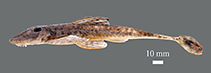
Dorsale zachte stralen (totaal) : 7; Anale stekels: 1; Anale zachte stralen: 5. Distinguished from all other species of Harttia except Harttia fluminensis and Harttia trombetensis by having an incomplete abdominal cover restricted to preanal and abdominal lateral plates with a row of platelets joining these two series of plates (vs. absence of row of platelets making junction between preanal and lateral abdominal plates), and by its specific barcode sequence (JF292262). Differs from Harttia fluminensis by having a shallower head (31.96-38.77, mean 36.52 ± 1.80% of HL, vs. 37.31-43.30, mean 38.94 ± 1.42% of HL); and from Harttia trombetensis by the color pattern of the caudal fin (a dark rounded blotch at base of caudal fin, vs. a large dark band). Four morphometric
variables strictly characterize Harttia tuna: longer head (mean = 24.97 ± 1.14%
of SL vs 23.19 ± 1.33 < mean < 24.15 ± 1.38% of SL); greater predorsal length (mean = 33.58 ± 0.84% of SL vs. 32.10 ± 1.05 < mean < 33. 01 ± 1.11% of SL); smaller postdorsal length (mean = 55.44 ± 1.10% of SL vs 56.63 ± 0.94 < mean < 57.35 ± 1.26% of SL); and smaller orbital diameter (mean = 20.97 ± 1.12% of HL vs. 22.68 ± 1.43 < mean < 23.37 ± 1.08% of HL) (Ref. 90209).
Body shape (shape guide): elongated.
Levenscyclus en paargedrag
Maturiteit | Voortplanting | Paaien | Eieren | Fecunditeit | Larven
Covain, R., S. Fisch-Muller, J.I. Montoya-Burgos, J.H. Mol, P.-Y. Le Bail and S. Day, 2012. The Harttiini (Siluriformes, Loricariidae) from the Guianas: a multi-table approach to assess their diversity, evolution, and distribution. Cybium 36(1):115-161. (Ref. 90209)
Status op de Rode Lijst van het IUCN (Ref. 130435: Version 2025-2 (Global))
Gevaar voor de mens
Harmless
Gebruik door de mens
Tools
Speciale rapporten
Download XML
Internetbronnen
Schattingen op basis van modellen
Fylogenetische diversiteitsindex (Ref.
82804): PD
50 = 0.5000 [Uniqueness, from 0.5 = low to 2.0 = high].
Bayesian length-weight: a=0.00589 (0.00267 - 0.01297), b=3.07 (2.90 - 3.24), in cm total length, based on LWR estimates for this Genus-body shape (Ref.
93245).
Trofisch niveau (Ref.
69278): 2.5 ±0.2 se; based on size and trophs of closest relatives
Weerstandsvermogen (Ref.
120179): Gemiddeld, minimale populatieverdubbelingstijd 1,4-4,4 jaar (Preliminary K or Fecundity.).
Kwetsbaarheid van de visserij (Ref.
59153): Low vulnerability (11 of 100).
🛈