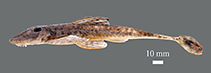
Классификация / Имена
народные названия | синонимы | Catalog of Fishes(род, виды) | ITIS | CoL | WoRMS | Cloffa
>
Siluriformes (Catfishes) >
Loricariidae (Armored catfishes) > Loricariinae
Etymology: tuna: The specific name 'tuna' is from the Amerindian Trio-Wayana meaning river, water. It refers to Harttia fluminensis, which has a name with the same meaning, because of their extreme morphological resemblance. A name used in apposition.
Eponymy: Charles Frederick Hartt (1840–1878) was a Canadian geologist, palaeontologist and naturalist, who was a member of the Thayer Expedition (1865–1866) to Brazil, a country in which he was a specialist. [...] (Ref. 128868), visit book page.
Окружающая среда: среда / климатическая зона / пределы глубины / диапазон распространения
экология
; пресноводный демерсальный. Tropical
South America: Upper Paru de Oeste River.
Размер / Вес / Возраст
половая зрелость: Lm ? range ? - ? cm
Max length : 17.2 cm SL самец/пол неопределен; (Ref. 90209)
Краткое описание
определительные ключи | морфология | морфометрия
членистые (мягкие) лучи спинного плавника (общее число) : 7; колючие лучи анального плавника: 1; членистые (мягкие) лучи анального плавника: 5. Distinguished from all other species of Harttia except Harttia fluminensis and Harttia trombetensis by having an incomplete abdominal cover restricted to preanal and abdominal lateral plates with a row of platelets joining these two series of plates (vs. absence of row of platelets making junction between preanal and lateral abdominal plates), and by its specific barcode sequence (JF292262). Differs from Harttia fluminensis by having a shallower head (31.96-38.77, mean 36.52 ± 1.80% of HL, vs. 37.31-43.30, mean 38.94 ± 1.42% of HL); and from Harttia trombetensis by the color pattern of the caudal fin (a dark rounded blotch at base of caudal fin, vs. a large dark band). Four morphometric
variables strictly characterize Harttia tuna: longer head (mean = 24.97 ± 1.14%
of SL vs 23.19 ± 1.33 < mean < 24.15 ± 1.38% of SL); greater predorsal length (mean = 33.58 ± 0.84% of SL vs. 32.10 ± 1.05 < mean < 33. 01 ± 1.11% of SL); smaller postdorsal length (mean = 55.44 ± 1.10% of SL vs 56.63 ± 0.94 < mean < 57.35 ± 1.26% of SL); and smaller orbital diameter (mean = 20.97 ± 1.12% of HL vs. 22.68 ± 1.43 < mean < 23.37 ± 1.08% of HL) (Ref. 90209).
Body shape (shape guide): elongated.
Жизненный цикл и брачное поведение
половая зрелость | размножение | нерест | икра | Плодовитость | личинки
Covain, R., S. Fisch-Muller, J.I. Montoya-Burgos, J.H. Mol, P.-Y. Le Bail and S. Day, 2012. The Harttiini (Siluriformes, Loricariidae) from the Guianas: a multi-table approach to assess their diversity, evolution, and distribution. Cybium 36(1):115-161. (Ref. 90209)
Статус Красного Списка МСОП (Ref. 130435: Version 2025-2 (Global))
Угроза для людей
Harmless
Использование человеком
дополнительная информация
инструменты
Специальные отчеты
Скачать в формате XML
ресурсы в Интернет
Оценки, основанные на моделях
Индекс филогенетического разнообразия (ссылка
82804): PD
50 = 0.5000 [Uniqueness, from 0.5 = low to 2.0 = high].
Bayesian length-weight: a=0.00589 (0.00267 - 0.01297), b=3.07 (2.90 - 3.24), in cm total length, based on LWR estimates for this Genus-body shape (Ref.
93245).
Трофический уровень (ссылка
69278): 2.5 ±0.2 se; based on size and trophs of closest relatives
устойчивость к внешним воздействиям (ссылка
120179): средний (среднего размера), минимальное время удвоения популяции 1.4-4.4 года (Preliminary K or Fecundity.).
Уязвимость рыбной ловли (Ref.
59153): Low vulnerability (11 of 100).
🛈