Classification / Noms
Noms communs | Synonymes | Catalog of Fishes(Genre, Espèce) | ITIS | CoL | WoRMS | Cloffa
>
Cypriniformes (Carps) >
Leuciscidae (Minnows) > Leuciscinae
Etymology: Alburnoides: From the city of Al Bura, where the fish was known + particle Greek, oides = similar (Ref. 45335); manyasensis: Derived from the name of Lake Manyas. An adjective.
Environnement : milieu / zone climatique / profondeur / gamme de distribution
Écologie
; eau douce benthopélagique. Subtropical
Asia: Koca Stream, drainage of Lake Manyas, Marmara Sea basin in Turkey.
Taille / Poids / Âge
Maturité: Lm ? range ? - ? cm
Max length : 12.7 cm TL mâle / non sexé; (Ref. 125982); poids max. publié: 22.92 g (Ref. 125982)
Description synthétique
Clés d'identification | Morphologie | Morphométrie
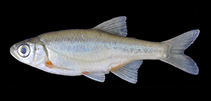
Rayons mous dorsaux (Total) : 11 - 13; Rayons mous anaux: 14 - 16; Vertèbres: 40 - 42. Distinguished from all congeners in Turkey and adjacent areas by a combination of the following characters (none unique to the species): ventral keel between pelvic fin and
anal fin partly or slightly developed; scaleless about 1/2 to 2/3 its length; upper body profile markedly convex, with marked hump at nape, especially in specimens larger than 60 mm SL; upper head profile straight or slightly convex in interorbital area, slightly convex on snout; corner of mouth reaching vertical through anterior margin of pupil; snout with slightly pointed
tip; interorbital width 7-8% SL; dark grey stripe indistinct or slightly distinct in anterior part of body but distinct in posterior body; pigmentation of lateral line slightly distinct in anterior part of body but indistinct in posterior part of body in most of specimens; scales on lateral-line 45-52+2-3; scale rows between lateral line and dorsal-fin origin 9-12; scale rows between lateral line and anal-fin origin 4-5; , anal fin with 10½-12½ branched rays; pharyngeal teeth 4.2-2.4, markedly hooked; and total vertebrae 40-42 (20-22, with mode of 21, abdominal and 19-21, with mode of 20, caudal vertebrae) (Ref. 91784).
Body shape (shape guide): fusiform / normal.
Occurs in clear fast running water with cobble and pebble substrates. Collected together with Capoeta tinca, Barbus oligolepis, Squalius cii, Vimba vimba, Chondrostoma sp., Rhodeus amarus, Oxynoemacheilus sp. and Alburnus sp. (Ref. 91784).
Cycle de vie et comportement reproducteur
Maturité | Reproduction | Frai | Œufs | Fécondité | Larves
Turan, D., F.G. Ekmekçi, C. Kaya and S.S. Güçlü, 2013. Alburnoides manyasensis (Actinopterygii, Cyprinidae), a new species of cyprinid fish form Manyas Lake basin, Turkey. Zookeys 276:85-102. (Ref. 91784)
Statut dans la liste rouge de l'IUCN (Ref. 130435: Version 2025-2 (Global))
Menace pour l'homme
Harmless
Utilisations par l'homme
Pêcheries: sans intérêt
Outils
Articles particuliers
Télécharger en XML
Sources Internet
Estimations basées sur des modèles
Indice de diversité phylogénétique (Réf.
82804): PD
50 = 0.5000 [Uniqueness, from 0.5 = low to 2.0 = high].
Bayesian length-weight: a=0.00776 (0.00413 - 0.01460), b=3.16 (3.00 - 3.32), in cm total length, based on LWR estimates for this species & Genus-body shape (Ref.
93245).
Niveau trophique (Réf.
69278): 3.1 ±0.4 se; based on size and trophs of closest relatives
Résilience (Réf.
120179): Haut, temps minimum de doublement de population inférieur à 15 mois (Preliminary K or Fecundity.).
Vulnérabilité de la pêche (Ref.
59153): Low vulnerability (10 of 100).
🛈