>
Characiformes (Characins) >
Hepsetidae (African pikes)
Etymology: Hepsetus: Greek, epsetas, -e, -on = boiled, but there is the following sentence: "oí epsetoi" = certain fishes, and also could be related to "psetta" = grouper (Ref. 45335).
Ambiente: milieu / zona climatica / distribuzione batimetrica / gamma di distribuzione
Ecologia
; acqua dolce demersale. Tropical
Africa: coastal basins from the Sanaga in Cameroon to the Chiloango in the Democratic Republic of the Congo (Ref. 93279). Also in the Dja River in Cameroon (Ref. 93279) and the middle Congo River basin in the Democratic Republic of the Congo (Ref. 108775).
Dimensione / Peso / Età
Maturità: Lm ? range ? - ? cm
Max length : 28.3 cm SL maschio/sesso non determinato; (Ref. 93279)
Breve descrizione
Chiavi di identificazione | Morfologia | Morfometria
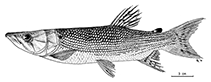
Diagnosis: Hepsetus lineatus can be distinguished from H. kingsleyae by a larger number of lateral line scales, 50–64 vs. 45–51, and lower number of gill rakers, 12–18, exceptionally 20 in one specimen, vs. 17–23; and by a larger head width, 32.8–46.7 vs. 26.4–35.6% of head length, and larger internasal distance, 21.5–29.3 vs. 15.6–23.3% of head length; the latter two characters are positively allometric (Ref. 93279). Hepsetus lineatus can only be distinguished from H. akawo by a larger number of lateral line scales, 50–64 vs. 43–51, and a smaller number of gill rakers, 12–18, exceptionally up to 20, vs. 17–23 (Ref. 93279). Hepsetus lineatus can be distinguished from H. odoe by a combination of a large internasal distance, 21.5–29.3 vs. 19.5–25.3% of head length, and a small distance between nostril and lower jaw, 36.8–44.4 vs. 40.4–47.6% of head length; both latter characters are positively allometric (Ref. 93279). Hepsetus lineatus can be distinguished from H. cuvieri by a higher number of gill rakers, 12–20 vs. 8–13, a lower number of scales between the dorsal fin and lateral line, 7.5–9.5 vs. 10.5–11.5, a lower number of scales between the adipose fin and lateral line, 4–5.5 vs. 6.5–7.5, and also by a greater head width, 32.8–46.7 vs. 27.8–40.4% of head length, and smaller internasal distance, 21.5–29.3 vs. 27.8–40.4% of head length; latter two characters positively allometric (Ref. 93279).
Body shape (shape guide): elongated.
Ciclo vitale e comportamento di accoppiamento
Maturità | Riproduzione | Deposizione | Uova | Fecondità | Larve
Decru, E., E. Vreven and J. Snoeks, 2013. A revision of the Lower Guinean Hepsetus species (Characiformes; Hepsetidae) with the description of Hepsetus kingsleyae sp. nov. J. Fish Biol. 82(4):1351-1375. (Ref. 93279)
Stato della Lista Rossa IUCN (Ref. 130435: Version 2025-2 (Global))
Minaccia per l'uomo
Harmless
Usi umani
Strumenti
Rapporti speciali
Scarica XML
Fonti Internet
Stime basate su modelli
Indice di diversità filogenetica (Fonte Biblio.
82804): PD
50 = 0.5312 [Uniqueness, from 0.5 = low to 2.0 = high].
Bayesian length-weight: a=0.00479 (0.00201 - 0.01138), b=3.17 (2.96 - 3.38), in cm total length, based on LWR estimates for this (Sub)family-body shape (Ref.
93245).
Livello trofico (Fonte Biblio.
69278): 3.0 ±0.4 se; based on size and trophs of closest relatives
Resilienza (Fonte Biblio.
120179): Alto, tempo minimo di raddoppiamento della popolazione meno di 15 mesi (Preliminary K or Fecundity.).
Vulnerabilità della pesca (Ref.
59153): Low vulnerability (25 of 100).
🛈