This website uses cookies to enhance your browsing experience and ensure the functionality of our site. For more detailed information about the types of cookies we use and how we protect your privacy, please visit our Privacy Information page.
×
Cookie Settings
This website uses different types of cookies to enhance your experience. Please select your preferences below:
> Characiformes (Characins) > Hepsetidae (African pikes)
Etymology: Hepsetus:Greek, epsetas, -e, -on = boiled, but there is the following sentence: "oí epsetoi" = certain fishes, and also could be related to "psetta" = grouper (Ref. 45335).
Africa: coastal basins from the Sanaga in Cameroon to the Chiloango in the Democratic Republic of the Congo (Ref. 93279). Also in the Dja River in Cameroon (Ref. 93279) and the middle Congo River basin in the Democratic Republic of the Congo (Ref. 108775).
サイズ / 重さ / 年齢
成熟: Lm? range ? - ? cm Max length : 28.3 cm SL オス/雌雄の選別がない; (Ref. 93279)
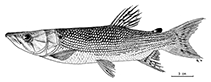
Diagnosis: Hepsetus lineatus can be distinguished from H. kingsleyae by a larger number of lateral line scales, 50–64 vs. 45–51, and lower number of gill rakers, 12–18, exceptionally 20 in one specimen, vs. 17–23; and by a larger head width, 32.8–46.7 vs. 26.4–35.6% of head length, and larger internasal distance, 21.5–29.3 vs. 15.6–23.3% of head length; the latter two characters are positively allometric (Ref. 93279). Hepsetus lineatus can only be distinguished from H. akawo by a larger number of lateral line scales, 50–64 vs. 43–51, and a smaller number of gill rakers, 12–18, exceptionally up to 20, vs. 17–23 (Ref. 93279). Hepsetus lineatus can be distinguished from H. odoe by a combination of a large internasal distance, 21.5–29.3 vs. 19.5–25.3% of head length, and a small distance between nostril and lower jaw, 36.8–44.4 vs. 40.4–47.6% of head length; both latter characters are positively allometric (Ref. 93279). Hepsetus lineatus can be distinguished from H. cuvieri by a higher number of gill rakers, 12–20 vs. 8–13, a lower number of scales between the dorsal fin and lateral line, 7.5–9.5 vs. 10.5–11.5, a lower number of scales between the adipose fin and lateral line, 4–5.5 vs. 6.5–7.5, and also by a greater head width, 32.8–46.7 vs. 27.8–40.4% of head length, and smaller internasal distance, 21.5–29.3 vs. 27.8–40.4% of head length; latter two characters positively allometric (Ref. 93279).
Body shape (shape guide): elongated.
Decru, E., E. Vreven and J. Snoeks, 2013. A revision of the Lower Guinean Hepsetus species (Characiformes; Hepsetidae) with the description of Hepsetus kingsleyae sp. nov. J. Fish Biol. 82(4):1351-1375. (Ref. 93279)
IUCNのレッドリストの状況は (Ref. 130435: Version 2025-2 (Global))
系統多様性指数 (参照 82804): PD50 = 0.5312 [Uniqueness, from 0.5 = low to 2.0 = high].
Bayesian length-weight: a=0.00479 (0.00201 - 0.01138), b=3.17 (2.96 - 3.38), in cm total length, based on LWR estimates for this (Sub)family-body shape (Ref. 93245).
栄養段階 (参照 69278): 3.0 ±0.4 se; based on size and trophs of closest relatives
回復力 (参照 120179): 高い, 15か月以下の倍増期間の最小個体群 (Preliminary K or Fecundity.).
漁業の脆弱性 (Ref. 59153): Low vulnerability (25 of 100). 🛈