Élasmobranches (requins et raies) (sharks and rays) >
Carcharhiniformes (Ground sharks) >
Sphyrnidae (Hammerhead, bonnethead, or scoophead sharks)
Etymology: Sphyrna: Probable misspelling of sphyra (Gr.), hammer, referring to their hammer-shaped heads (See ETYFish); gilberti: In honor of ichthyologist Carter R. Gilbert (b. 1930), Florida State Museum of Natural History, who first reported (1967) an anomalous specimen of S. lewini that is likely the first recorded individual of this species (See ETYFish).
Eponymy: Dr Carter Rowell Gilbert (1930-2022) was an American zoologist and ichthyologist. [...] (Ref. 128868), visit book page.
Environnement : milieu / zone climatique / profondeur / gamme de distribution
Écologie
marin pelagic-neritic; océanodrome (Ref. 87829). Subtropical
Distribution
Territoires | Zones FAO | Écosystèmes | Occurrences | Carte par point | Introductions | Faunafri
Western Atlantic: South Carolina, USA.
Taille / Poids / Âge
Maturité: Lm ? range ? - ? cm
Max length : 47.1 cm OT mâle / non sexé; (Ref. 94083); 50.6 cm OT (female)
Description synthétique
Clés d'identification | Morphologie | Morphométrie
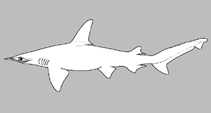
This species is distinguished from its congeners by having a head length greater than 20% of STL (stretched total length); cephalofoil has median indentation; with inner narial groove; pelvic fins with straight rear margins; 91 or fewer precaudal vertebrae (Ref. 94083).
Cross section: oval.
Measurements given in STL, stretch total length (Ref. 94083).
Cycle de vie et comportement reproducteur
Maturité | Reproduction | Frai | Œufs | Fécondité | Larves
Quattro, J.M., W.B.III Driggers, J.M. Grady, G.F. Ulrich and M.A. Roberts, 2013. Sphyrna gilberti sp. nov., a new hammerhead shark (Carcharhiniformes, Sphyrnidae) from the western Atlantic Ocean. Zootaxa 3702(2):159-178. (Ref. 94083)
Statut dans la liste rouge de l'IUCN (Ref. 130435: Version 2025-2 (Global))
Menace pour l'homme
Harmless
Utilisations par l'homme
Outils
Articles particuliers
Télécharger en XML
Sources Internet
Estimations basées sur des modèles
Indice de diversité phylogénétique (Réf.
82804): PD
50 = 0.5006 [Uniqueness, from 0.5 = low to 2.0 = high].
Bayesian length-weight: a=0.00355 (0.00159 - 0.00792), b=3.12 (2.93 - 3.31), in cm total length, based on LWR estimates for this (Sub)family-body shape (Ref.
93245).
Niveau trophique (Réf.
69278): 4.1 ±0.5 se; based on size and trophs of closest relatives
Résilience (Réf.
120179): Faible, temps minimum de doublement de population : 4,5 à 14 années (Preliminary K or Fecundity.).
Vulnérabilité de la pêche (Ref.
59153): Very high vulnerability (90 of 100).
🛈