Elasmobranquios (tiburones y rayas) (sharks and rays) >
Carcharhiniformes (Ground sharks) >
Sphyrnidae (Hammerhead, bonnethead, or scoophead sharks)
Etymology: Sphyrna: Probable misspelling of sphyra (Gr.), hammer, referring to their hammer-shaped heads (See ETYFish); gilberti: In honor of ichthyologist Carter R. Gilbert (b. 1930), Florida State Museum of Natural History, who first reported (1967) an anomalous specimen of S. lewini that is likely the first recorded individual of this species (See ETYFish).
Eponymy: Dr Carter Rowell Gilbert (1930-2022) was an American zoologist and ichthyologist. [...] (Ref. 128868), visit book page.
Entorno: milieu / zona climática / rango de profundidad / gama de distribución
Ecología
marino pelagic-neritic; oceanodromo (Ref. 87829). Subtropical
Distribución
Territorios | Áreas FAO | Ecosistemas | Ocurrencias, apariciones | Mapa de puntos | Introducciones | Faunafri
Western Atlantic: South Carolina, USA.
Tamaño / Peso / Edad
Madurez: Lm ? range ? - ? cm
Max length : 47.1 cm OT macho / no sexado; (Ref. 94083); 50.6 cm OT (female)
Descripción breve
Claves de identificación | Morfología | Morfometría
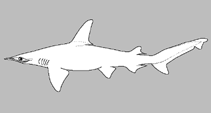
This species is distinguished from its congeners by having a head length greater than 20% of STL (stretched total length); cephalofoil has median indentation; with inner narial groove; pelvic fins with straight rear margins; 91 or fewer precaudal vertebrae (Ref. 94083).
Cross section: oval.
Measurements given in STL, stretch total length (Ref. 94083).
Ciclo vital y comportamiento de apareamiento
Madurez | Reproducción | Puesta | Huevos | Fecundidad | Larva
Quattro, J.M., W.B.III Driggers, J.M. Grady, G.F. Ulrich and M.A. Roberts, 2013. Sphyrna gilberti sp. nov., a new hammerhead shark (Carcharhiniformes, Sphyrnidae) from the western Atlantic Ocean. Zootaxa 3702(2):159-178. (Ref. 94083)
Situación en la Lista Roja de la UICN (Ref. 130435: Version 2025-2 (Global))
Amenaza para el ser humano
Harmless
Usos humanos
Herramientas
Informes especiales
Descargar XML
Fuentes de Internet
Estimaciones basadas en modelos
Índice de diversidad filogenética (Referencia
82804): PD
50 = 0.5006 [Uniqueness, from 0.5 = low to 2.0 = high].
Bayesian length-weight: a=0.00355 (0.00159 - 0.00792), b=3.12 (2.93 - 3.31), in cm total length, based on LWR estimates for this (Sub)family-body shape (Ref.
93245).
Nivel trófico (Referencia
69278): 4.1 ±0.5 se; based on size and trophs of closest relatives
Resiliencia (Referencia
120179): Bajo, población duplicada en un tiempo mínimo de 4.5-14 años (Preliminary K or Fecundity.).
Vulnerabilidad pesquera (Ref.
59153): Very high vulnerability (90 of 100).
🛈