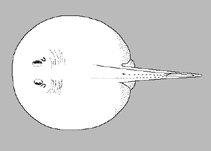
Ikan bertulang rawan (sharks and rays) >
Myliobatiformes (Stingrays) >
Potamotrygonidae (River stingrays) > Potamotrygoninae
Etymology: Potamotrygon: Greek, potamos = river + Greek, trygon = a sting ray (Ref. 45335); pantanensis: The species name pantanensis refers to the northern Pantanal region (Paraná-Paraguay basin) where this new species has been exclusively found to date.
Remarks. Sexual maturity of females occurs between.
Lingkungan: lingkungan / zona iklim / kisaran kedalaman / jangkauan distribusi
Ekologi
; air tawar bentopelagis. Tropical
South America: northern Pantanal region, Brazil.
Panjang pada saat jatuh tempo pertama / Ukuran / Berat / umur
Kematangan: Lm 35.5, range 24 - 47 cm
Max length : 26.8 cm WD jantan/; (Ref. 95047); 33.6 cm WD (female)
deskripsi pendek
Kunci identifiaksi (pengenalan) | Morfologi | Morfometrik
vertebrata, bertulang belakang: 118 - 125. Can be diagnosed from other species of the genus Potamotrygon from the Paraná-Paraguay basin by having bicolored ocelli with diameter greater or equal to eye-diameter, and vermiculated markings with a beige, yellow or orange central area surrounded by a peripheral black ring, over a uniform brown dorsal disc background color (vs. ocelli absent in P. falkneri, P. histrix, P. schuhmacheri, and P. brachyura; ocelli with three colors in P. motoro and two colors in P. amandae, and both species lack vermiculations). Can be further distinguished by the following combination of characters: a single, clearly demarcated gray color present on anterocentral ventral disc, transversed by a gray stripe over first pair of branchial slits (vs. lacking in P. motoro and P. amandae); presence of minute, star-shaped dermal denticles only on central disc area, and two or three rows of minute, slender and curved enlarged spines on dorsal tail (vs. a single dorsal row of relatively large, tall and straight enlarged spines on dorsal tail in P. motoro, and double or triple rows of small and straight spines in P. amandae); dorsal pseudosiphon of clasper with dorsal flap broader than in P. motoro and P. amandae (in P. pantanensis this flap covers an area beyond the anterior margin of dorsal pseudosiphon, whereas in P. motoro and P. amandae this flap is restricted to the dorsal pseudosiphon); 87 to 95 (without mode) pectoral radials and 30 to 31 (mode 31) tooth rows of lower jaw (vs P. amandae with 92 to 106 pectoral radials [without mode], and 23 to 33 lower tooth rows [mode 26]); a straight frontoparietal fontanelle with parallel margins (vs. frontoparietal fontanelle with slightly curved and tapering margins in P. motoro, and with posterior portion of frontoparietal fontanelle more rounded in P. amandae); anterior angular cartilage much greater than posterior angular cartilage, more than twice its length, and relatively straight anteriorly (vs. angular cartilages subequal in P. motoro; and anterior angular cartilage curved near articulation with Meckel’s cartilage, with anterior margin very concave in P. amandae) (Ref. 95047).
Siklus hidup dan perilaku kawin
Kematangan | Reproduksi, perkembang biakan | Pemijahan | telur-telur | Fekunditas | Larva
Loboda, T.S. and M.R. de Carvalho, 2013. Systematic revision of the Potamotrygon motoro (Müller & Henle, 1841) species coplex in the Paraná-Paraguay basin, with description of two new ocellated species (Chondrichthyes: Myliobatiformes: Potamotrygonidae). Neotrop. Ichthyol/ 11(4):693-737. (Ref. 95047)
Status IUCN Red List (Ref. 130435: Version 2025-2 (Global))
ancaman kepada manusia
Harmless
penggunaan manusia
Alat, peralatan
laporan khas
muat turun XML
Sumber internet
Estimasi berdasarkan model
Indeks keanekaragaman filogenetik (Acuan
82804): PD
50 = 0.5000 [Uniqueness, from 0.5 = low to 2.0 = high].
Bayesian length-weight: a=0.01000 (0.00244 - 0.04107), b=3.04 (2.81 - 3.27), in cm total length, based on all LWR estimates for this body shape (Ref.
93245).
Tingkat Trofik (Acuan
69278): 3.2 ±0.4 se; based on size and trophs of closest relatives
Kerentanan Penangkapan Ikan (Ref.
59153): High vulnerability (58 of 100).
🛈