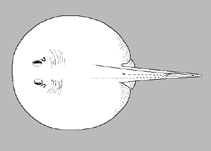
Elasmobranchii (tubarões e raias) (sharks and rays) >
Myliobatiformes (Stingrays) >
Potamotrygonidae (River stingrays) > Potamotrygoninae
Etymology: Potamotrygon: Greek, potamos = river + Greek, trygon = a sting ray (Ref. 45335); pantanensis: The species name pantanensis refers to the northern Pantanal region (Paraná-Paraguay basin) where this new species has been exclusively found to date.
Remarks. Sexual maturity of females occurs between.
Ambiente: milieu / zona climática / intervalo de profundidade / gama de distribuição
Ecologia
; Água doce bentopelágico. Tropical
South America: northern Pantanal region, Brazil.
Comprimento na primeira maturidade / Tamanho / Peso / Idade
Maturidade: Lm 35.5, range 24 - 47 cm
Max length : 26.8 cm WD macho/indeterminado; (Ref. 95047); 33.6 cm WD (female)
Descrição breve
Chaves de identificação | Morfologia | Morfometria
Vértebras: 118 - 125. Can be diagnosed from other species of the genus Potamotrygon from the Paraná-Paraguay basin by having bicolored ocelli with diameter greater or equal to eye-diameter, and vermiculated markings with a beige, yellow or orange central area surrounded by a peripheral black ring, over a uniform brown dorsal disc background color (vs. ocelli absent in P. falkneri, P. histrix, P. schuhmacheri, and P. brachyura; ocelli with three colors in P. motoro and two colors in P. amandae, and both species lack vermiculations). Can be further distinguished by the following combination of characters: a single, clearly demarcated gray color present on anterocentral ventral disc, transversed by a gray stripe over first pair of branchial slits (vs. lacking in P. motoro and P. amandae); presence of minute, star-shaped dermal denticles only on central disc area, and two or three rows of minute, slender and curved enlarged spines on dorsal tail (vs. a single dorsal row of relatively large, tall and straight enlarged spines on dorsal tail in P. motoro, and double or triple rows of small and straight spines in P. amandae); dorsal pseudosiphon of clasper with dorsal flap broader than in P. motoro and P. amandae (in P. pantanensis this flap covers an area beyond the anterior margin of dorsal pseudosiphon, whereas in P. motoro and P. amandae this flap is restricted to the dorsal pseudosiphon); 87 to 95 (without mode) pectoral radials and 30 to 31 (mode 31) tooth rows of lower jaw (vs P. amandae with 92 to 106 pectoral radials [without mode], and 23 to 33 lower tooth rows [mode 26]); a straight frontoparietal fontanelle with parallel margins (vs. frontoparietal fontanelle with slightly curved and tapering margins in P. motoro, and with posterior portion of frontoparietal fontanelle more rounded in P. amandae); anterior angular cartilage much greater than posterior angular cartilage, more than twice its length, and relatively straight anteriorly (vs. angular cartilages subequal in P. motoro; and anterior angular cartilage curved near articulation with Meckel’s cartilage, with anterior margin very concave in P. amandae) (Ref. 95047).
Ciclo de vida e comportamento de acasalamento
Maturidade | Reprodução | Desova | Ovos | Fecundidade | Larvas
Loboda, T.S. and M.R. de Carvalho, 2013. Systematic revision of the Potamotrygon motoro (Müller & Henle, 1841) species coplex in the Paraná-Paraguay basin, with description of two new ocellated species (Chondrichthyes: Myliobatiformes: Potamotrygonidae). Neotrop. Ichthyol/ 11(4):693-737. (Ref. 95047)
Categoria na Lista Vermelha da IUCN (Ref. 130435: Version 2025-2 (Global))
Ameaça para o homem
Harmless
Utilização humana
Ferramentas
Relatórios especiais
Descarregue XML
Fontes da internet
Estimativas baseadas em modelos
Índice de diversidade filogenética (Ref.
82804): PD
50 = 0.5000 [Uniqueness, from 0.5 = low to 2.0 = high].
Bayesian length-weight: a=0.01000 (0.00244 - 0.04107), b=3.04 (2.81 - 3.27), in cm total length, based on all LWR estimates for this body shape (Ref.
93245).
Nível Trófico (Ref.
69278): 3.2 ±0.4 se; based on size and trophs of closest relatives
Vulnerabilidade da pesca (Ref.
59153): High vulnerability (58 of 100).
🛈