Klassificering / Namn
Populärnamn | synonymer | Catalog of Fishes(Släkte, Arter) | ITIS | CoL | WoRMS | Cloffa
>
Cypriniformes (Carps) >
Cyprinidae (Minnows or carps) > Smiliogastrinae
Etymology: Pethia: Pethia is the generic vernacular name for small cyprinids in Sinhala; lutea: The specific name 'lutea' is Latin for yellow and is named in reference to the bright yellow colored body in life. Gender feminine.
Miljö: miljö / Klimatzon / djupintervall / distributionsområde
Ekologi
; sötvatten bentopelagisk. Tropical
Asia: Maharashtra State, India.
Storlek / Vikt / Ålder
Könsmognad: Lm ? range ? - ? cm
Max length : 3.9 cm SL hane/ej könsbestämd; (Ref. 96472)
Kort beskrivning
Bestämningsnycklar | Morfologi | Morfometri
Mjukstrålar i ryggfenan (totalt) : 11; Mjukstrålar i analfenan: 8; Ryggkotor: 30. Distinguished from other species of Pethia by the combination of the following characters: distinct humped nape; no barbels; lips fleshy; distinct lateral fold on snout; complete lateral line; 19-22 pored lateral line scales; 8 predorsal scales; 9-10 prepelvic scales; 14-15 preanal scales; 4½-4 scales between dorsal fin origin and lateral line, and 2½-3 scale between lateral line and pelvic fin origin; last simple dorsal fin ray strong and serrated with 6-9 serrae on distal half of spine whereas 2-4 on apical half of spine; 13-15 branched pectoral fin rays; seven branched pelvic fin rays; caudal fin with 6-7+6-7 principal rays and 8-9+8-9 branched rays; 5 supraneurals; 6 predorsal neural spine; deep and enlarged infraorbital three; gill rakers three on epibranchial, one at angle and 14-15 on first ceratobranchial; one humeral band covering 3rd and 4th lateral line scale and extends to one scale up and down; one caudal blotch encircling caudal peduncle dorsally covering 17th-19th lateral line scale; dorsal fin without any bands and body dark yellow with iridescence on scale (Ref. 96472).
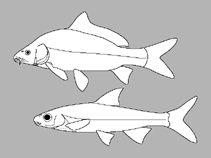
Body shape (shape guide): fusiform / normal.
Occurs in riffles and runs with boulders and gravels as substratum. Encountered only in clear unpolluted river stretches with well oxygenated waters and were not observed in pools and ditches. Adults are mostly found in association with submerged vegetation. Occurs together with other fish species of genera Salmostoma, Devario, Dawkinsia, Garra, Puntius, Systomus and Anguilla (Ref. 96472).
Livscykel och parningsbeteende
Könsmognad | Reproduktion | Lek | Ägg | Fekunditet | Larver
Katwate, U., C. Katwate, R. Raghavan, M.S. Paingankar and N. Dahanukar, 2014. Pethia lutea, a new species of barb (Teleostei: Cyprinidae) and new records of P. Punctata from Northern Western Ghats of India. J. Threatened Taxa 6(6):5797-5818. (Ref. 96472)
Status på IUCN:s rödlista (Ref. 130435: Version 2025-2 (Global))
Hot mot människor
Harmless
Mänskliga användningsområden
Verktyg
Särskilda rapporter
Ladda ner XML
Internet-källor
Uppskattningar baserade på modeller
Index för fylogenetisk mångfald (Ref.
82804): PD
50 = 0.5000 [Uniqueness, from 0.5 = low to 2.0 = high].
Bayesian length-weight: a=0.01047 (0.00454 - 0.02413), b=3.00 (2.83 - 3.17), in cm total length, based on LWR estimates for this Genus-body shape (Ref.
93245).
Trofisk nivå (Ref.
69278): 2.7 ±0.2 se; based on size and trophs of closest relatives
Resiliens (Ref.
120179): Hög, lägsta populationsfördubblingstid mindre än 15 månader (Preliminary K or Fecundity.).
Sårbarhet i fisket (Ref.
59153): Low vulnerability (10 of 100).
🛈