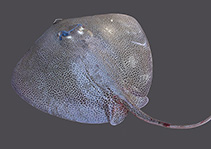
Himantura tutul, Fine-spotted leopard whipray : fisheries

You can sponsor this page

Himantura tutul Borsa, Durand, Shen, Alyza, Solihin & Berrebi, 2013

Fine-spotted leopard whipray
Hochladen Photos und videos
Bilder | Google Bild
Image of Himantura tutul (Fine-spotted leopard whipray)
Himantura tutul
Photo von Durand, J.-D. / Borsa, P.

Klassifizierung / Names Namen | Synonyme | Catalog of Fishes(Gattung, Arten) | ITIS | CoL | WoRMS | Cloffa

Elasmobranchii (Haie und Rochen) (sharks and rays) > Myliobatiformes (Stingrays) > Dasyatidae (Stingrays) > Urogymninae
Etymology: Himantura: Greek, iman, imantos = thong, strap + Greek, oura = tail (Ref. 45335)tutul: Malay word tutul which means 'spotted', referring to leopard-like markings on the dorsal surface of large specimens (>1 m DW).

Umwelt: Milieu / Klimazone / Tiefenbereich / Verbreitungsgebiet Ökologie

seewasser demersal. Tropical

Verbreitung Territorien | FAO Gebiete | Ökosysteme | Vorkommen | Punkt Karte | Einführungen | Faunafri

Indo-West Pacific: from the coast of Tanzania, to Laccadive Sea and Indo-Malay Archipelago, including Sunda Strait area, southern coast of Java Island, the Bali Sea, eastern South China Sea and Sulu Sea (Sabah).

Größe / Gewicht / Alter

Geschlechtsreife: Lm ?  range ? - ? cm
Max length : 115.0 cm WD (female)

Biologie     Fachlexikon (Englisch) (z.B. epibenthic)

Lebenszyklus und Paarungsverhalten Geschlechtsreife | Fortpflanzung | Ablaichen | Eier | Fruchtbarkeit | Larven

Hauptreferenz Laden Sie Ihre Referenzen hoch | Referenzen | Koordinator : McEachran, John | Partner

Borsa, P., J.-D. Durand, K.N. Shen, I.S. Arlyza, D.D. Solihin and P. Berrebi, 2013. Himantura tutul sp. nov. (Myliobatoidei: Dasyatidae), a new ocellated whipray from the tropical Indo-West Pacific, described from its cytochrome-oxidase I gene sequence. Comptes Rendus Biologies 336:82-92. (Ref. 93847)

IUCN Rote Liste Status (Ref. 130435: Version 2025-2 (Global))


CITES

Not Evaluated

CMS (Ref. 116361)

Not Evaluated

Bedrohung für Menschen

  Traumatogenic (Ref. 114953)


Nutzung durch Menschen

Fischereien: weniger kommerziell
FAO - Publication: search | FishSource |

Mehr Information

Trophische Ökologie
Lebensmittel (Beutetiere)
Nahrungszusammensetzung
Nahrungsaufnahme
Lebensmittelrationen
Räuber
Ökologie
Ökologie
Populationsdynamik
Wachstumsparameter
Max. Alter/Größen
Länge-Gewicht-Rel.
Länge-Länge-Verhältnis.
Längenhäufigkeiten
Massenkonvertierung
Rekrutierung
Dichte
Lebenszyklus
Fortpflanzung
Geschlechtsreife
Reifung/Kiemen rel.
Fruchtbarkeit
Ablaichen
Laichaggregationen
Eier
Eientwicklung
Larven
Larven Pop.Dyn.
Verbreitung
Territorien
FAO Gebiete
Ökosysteme
Vorkommen
Einführungen
BRUVS - Videos
Anatomie
Kiemenoberfläche
Gehirn
Otolith
Physiologie
Körperliche Zusammensetzung
Nährstoffe
Sauerstoffverbrauch
Schwimmart
Schwimmgeschwindigkeit
Visuelle Pigmente
Fischgeräusche
Krankheiten und Parasiten
Toxizität (LC50s)
Genetik
Genom
Genetik
Heterozygotie
Vererbbarkeit
Genetische Vielfalt
Menschenbezogen
Aquakultur-Systeme
Aquakultur Profile
Zuchtlinien
Ciguatera-Fälle
Briefmarken, Münzen, Verschiedenes.
Aufsuchen
Partner
Taxonomie
Namen
Synonyme
Morphologie
Morphometrie
Bilder
Referenzen
Referenzen

Tools

Zusatzinformationen

Download XML

Internet Quellen

AFORO (otoliths) | Aquatic Commons | BHL | Cloffa | Websites from users | FishWatcher Einträge suchen | CISTI | Catalog of Fishes: Gattung, Arten | DiscoverLife | ECOTOX | FAO - Publication: search | Faunafri | Fishipedia | Fishtrace | GloBI | Google Books | Google Scholar | Google | IGFA World Record | OneZoom | Open Tree of Life | Otolith Atlas of Taiwan Fishes | PubMed | Reef Life Survey | Socotra Atlas | TreeBase | Tree of Life | Wikipedia: Gehe zu, Suchen | World Records Freshwater Fishing | Zoobank | Zoologischer Rekord

Schätzungen auf der Grundlage von Modellen

Phylogenetischer Diversitätsindex (Ref. 82804):  PD50 = 0.5002   [Uniqueness, from 0.5 = low to 2.0 = high].
Bayesian length-weight: a=0.01023 (0.00482 - 0.02174), b=3.06 (2.86 - 3.26), in cm total length, based on LWR estimates for this (Sub)family-body shape (Ref. 93245).
Trophische Ebene (Ref. 69278):  3.6   ±0.5 se; based on size and trophs of closest relatives
Anfälligkeit der Fischerei (Ref. 59153):  Very high vulnerability (90 of 100). 🛈