Clasificación / Nombres
Nombres comunes | Sinónimos | Catalog of Fishes(Género, Especie) | ITIS | CoL | WoRMS | Cloffa
>
Cichliformes (Cichlids, convict blennies) >
Cichlidae (Cichlids) > Cichlasomatinae
Etymology: Bujurquina: A name created by Kullander, taken from a native Peruvian word for these cichlids, "bujurqui" or "bufurque"; 1983-1986; pardus: From the Ancient Greek pardos, meaning leopard, in allusion to the pattern of dark blackish/brown flank spots. A noun in apposition.
Entorno: milieu / zona climática / rango de profundidad / gama de distribución
Ecología
; agua dulce bentopelágico; pH range: 6.4 - ?; rango de profundidad 1 - ? m (Ref. 96081). Tropical; 24°C - ? (Ref. 96081)
South America: Rio Danta, Rio Tigre drainage in Ecuador.
Tamaño / Peso / Edad
Madurez: Lm ? range ? - ? cm
Max length : 7.7 cm SL macho / no sexado; (Ref. 96081)
Descripción breve
Claves de identificación | Morfología | Morfometría
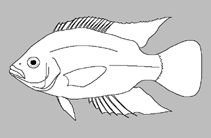
Espinas dorsales (total) : 13 - 14; Radios blandos dorsales (total) : 9 - 10; Espinas anales: 3; Radios blandos anales: 8. Bujurquina pardus is distinguished from all other congeners by having small, square or tapered black spots ('pardus type') in the region of overlap between the scale base and the anterior overlaying scale's margin. It differs from all other Bujurquina species (B. huallagae, B. moriorum, B. peregrinabunda, and B. ortegai) by the presence of white hyaline margins on the dorsal-fin lappets. It can be distinguished from all congeners except B. eurhinus, B. robusta, B. labiosa, B. huallagae, and B. oenolaemus by having a short pectoral fins (<32% of SL). It further differs from B. oenolaemus, B. cordemadi, B. tambopatae, B. eurhinus, B. labiosa, B. robusta, B. apoparuana, B. hophrys, B. megalospilus, B. ortegai, B. mariae, and B. zamorensis by the presence of light spotting on the spinous dorsal fin. It can be diagnosed from a very similar species B. huallagae, on the basis of the presence of white dorsal-fin lappet margins (rather than black), a strongly curved suborbital stripe (rather than straight or nearly straight), a complete bar 7 (rather than divided), and in having faint buccal stripes (rather than dark buccal spots) (Ref. 96081).
Found in a whitewater habitat of Rio Danta with a substrate of sand and silt, a relatively fast current, little aquatic vegetation and primary forest on the riverbanks. Collected with 4 m seines from the middle of the current at a depth of 1.2 m (Ref. 96081).
Ciclo vital y comportamiento de apareamiento
Madurez | Reproducción | Puesta | Huevos | Fecundidad | Larva
Arbour, J.H., R.E.B. Salazar and H. López-Fernández, 2014. A new species of Bujurquina (Teleostei: Cichlidae) from the Río Danta, Ecuador, with a key to the species in the genus. Copeia 2014(1):79-86. (Ref. 96081)
Situación en la Lista Roja de la UICN (Ref. 130435: Version 2025-2 (Global))
Amenaza para el ser humano
Harmless
Usos humanos
Herramientas
Informes especiales
Descargar XML
Fuentes de Internet
Estimaciones basadas en modelos
Índice de diversidad filogenética (Referencia
82804): PD
50 = 0.5000 [Uniqueness, from 0.5 = low to 2.0 = high].
Bayesian length-weight: a=0.02188 (0.01025 - 0.04670), b=3.05 (2.87 - 3.23), in cm total length, based on LWR estimates for this (Sub)family-body shape (Ref.
93245).
Nivel trófico (Referencia
69278): 3.4 ±0.6 se; based on size and trophs of closest relatives
Resiliencia (Referencia
120179): Alto, población duplicada en un tiempo mínimo inferior a 15 meses (Preliminary K or Fecundity.).
Vulnerabilidad pesquera (Ref.
59153): Low vulnerability (10 of 100).
🛈