Klassificering / Namn
Populärnamn | synonymer | Catalog of Fishes(Släkte, Arter) | ITIS | CoL | WoRMS | Cloffa
>
Cichliformes (Cichlids, convict blennies) >
Cichlidae (Cichlids) > Cichlasomatinae
Etymology: Bujurquina: A name created by Kullander, taken from a native Peruvian word for these cichlids, "bujurqui" or "bufurque"; 1983-1986; pardus: From the Ancient Greek pardos, meaning leopard, in allusion to the pattern of dark blackish/brown flank spots. A noun in apposition.
Miljö: miljö / Klimatzon / djupintervall / distributionsområde
Ekologi
; sötvatten bentopelagisk; pH range: 6.4 - ?; djupintervall 1 - ? m (Ref. 96081). Tropical; 24°C - ? (Ref. 96081)
South America: Rio Danta, Rio Tigre drainage in Ecuador.
Storlek / Vikt / Ålder
Könsmognad: Lm ? range ? - ? cm
Max length : 7.7 cm SL hane/ej könsbestämd; (Ref. 96081)
Kort beskrivning
Bestämningsnycklar | Morfologi | Morfometri
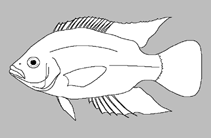
Taggstrålar i ryggfenan (totalt) : 13 - 14; Mjukstrålar i ryggfenan (totalt) : 9 - 10; Taggstrålar i analfenan: 3; Mjukstrålar i analfenan: 8. Bujurquina pardus is distinguished from all other congeners by having small, square or tapered black spots ('pardus type') in the region of overlap between the scale base and the anterior overlaying scale's margin. It differs from all other Bujurquina species (B. huallagae, B. moriorum, B. peregrinabunda, and B. ortegai) by the presence of white hyaline margins on the dorsal-fin lappets. It can be distinguished from all congeners except B. eurhinus, B. robusta, B. labiosa, B. huallagae, and B. oenolaemus by having a short pectoral fins (<32% of SL). It further differs from B. oenolaemus, B. cordemadi, B. tambopatae, B. eurhinus, B. labiosa, B. robusta, B. apoparuana, B. hophrys, B. megalospilus, B. ortegai, B. mariae, and B. zamorensis by the presence of light spotting on the spinous dorsal fin. It can be diagnosed from a very similar species B. huallagae, on the basis of the presence of white dorsal-fin lappet margins (rather than black), a strongly curved suborbital stripe (rather than straight or nearly straight), a complete bar 7 (rather than divided), and in having faint buccal stripes (rather than dark buccal spots) (Ref. 96081).
Found in a whitewater habitat of Rio Danta with a substrate of sand and silt, a relatively fast current, little aquatic vegetation and primary forest on the riverbanks. Collected with 4 m seines from the middle of the current at a depth of 1.2 m (Ref. 96081).
Livscykel och parningsbeteende
Könsmognad | Reproduktion | Lek | Ägg | Fekunditet | Larver
Arbour, J.H., R.E.B. Salazar and H. López-Fernández, 2014. A new species of Bujurquina (Teleostei: Cichlidae) from the Río Danta, Ecuador, with a key to the species in the genus. Copeia 2014(1):79-86. (Ref. 96081)
Status på IUCN:s rödlista (Ref. 130435: Version 2025-2 (Global))
Hot mot människor
Harmless
Mänskliga användningsområden
Verktyg
Särskilda rapporter
Ladda ner XML
Internet-källor
Uppskattningar baserade på modeller
Index för fylogenetisk mångfald (Ref.
82804): PD
50 = 0.5000 [Uniqueness, from 0.5 = low to 2.0 = high].
Bayesian length-weight: a=0.02188 (0.01025 - 0.04670), b=3.05 (2.87 - 3.23), in cm total length, based on LWR estimates for this (Sub)family-body shape (Ref.
93245).
Trofisk nivå (Ref.
69278): 3.4 ±0.6 se; based on size and trophs of closest relatives
Resiliens (Ref.
120179): Hög, lägsta populationsfördubblingstid mindre än 15 månader (Preliminary K or Fecundity.).
Sårbarhet i fisket (Ref.
59153): Low vulnerability (10 of 100).
🛈