This website uses cookies to enhance your browsing experience and ensure the functionality of our site. For more detailed information about the types of cookies we use and how we protect your privacy, please visit our Privacy Information page.
×
Cookie Settings
This website uses different types of cookies to enhance your experience. Please select your preferences below:
分类 / 名称 俗名 | 同种异名 | Catalog of Fishes(属, 种) | ITIS | CoL | WoRMS | Cloffa
Teleostei > Synbranchiformes (Spiny eels) > Mastacembelidae (Spiny eels)
Etymology: Macrognathus:Greek, makros = great + Greek, gnathos = jaw (Ref. 45335); albus:The specific name is derived from the Latin language meaning ‘white’, in reference to the color of the new fish.
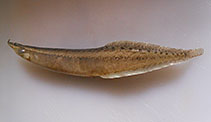
背棘 (总数) : 26 - 30; 背的软条 (总数) : 62 - 65; 臀棘: 3; 臀鳍软条: 56 - 62. Macrognathus albus can be distinguished by the following characters: absence of any bands or bars on body; 26- 29 irregular blotches on mid dorsal line from top of operculum to base of caudal; absence of pre-orbital spine; spinous part of dorsal fin originating considerably behind the end of pectoral fin; head longer and deeper, eyes located closely, body width lesser, pre dorsal and pre anal distances greater (Ref. 97143).
The type locality, Manimala River, is highly sinuous and generally rocky with deep pools at certain locations and sand deposit occurring as sporadic patches or fillings in the pools. It has more or less scanty riparian vegetation. The river has bed materials generally of coarser grade and very low sand content. The width of the river channel ranges from 45-110 m and water depth in the active channel during summer seasons ranges from 0.5 m-3 m. This species occurs together with the following fish species: Anguilla bengalensis, Salmostoma boopis, Danio malabaricus, Barilius bakeri, Gonoproktopterus kurali, Rasbora daniconius, Puntius mahecola, Haludaria fasciatus, Pethia ticto, Dawkinsia filamentosa, Systomus subnasutus, Batasio travancoria, Ompok malabaricus, Clarias dussumieri, Heteropneustes fossilis, Mesonoemacheilus triangularis, Bhavania australis, Xenentodon cancila, Aplocheilus lineatus, Parambassis thomassi, Etroplus maculatus, Etroplus suratensis, Anabas testudineus, Pristolepis malabaricus, Mastacembelus armatus, Macrognathus guentheri, etc. (Ref. 97143).
Plamoottil, M. and N.P. Abraham, 2014. Macrognathus albus (order: Synbranchiformes; family: Mastacembelidae), a new fish species from Kerala, India. Intl. J. Pure Appl. Zool. 2(2):100-105. (Ref. 97143)
世界自然保护联盟红皮书 (Ref. 130435: Version 2025-2 (Global))
系统发育多样性指数 (参考文献 82804): PD50 = 0.5000 [Uniqueness, from 0.5 = low to 2.0 = high].
Bayesian length-weight: a=0.00427 (0.00189 - 0.00961), b=3.02 (2.81 - 3.23), in cm total length, based on LWR estimates for this (Sub)family-body shape (Ref. 93245).
营养阶层 (参考文献 69278): 3.3 ±0.4 se; based on size and trophs of closest relatives
回复力 (参考文献 120179): 高度, 族群倍增时间少于 15个月 (Preliminary K or Fecundity.).
渔业脆弱性 (Ref. 59153): Low vulnerability (16 of 100). 🛈