>
Synbranchiformes (Spiny eels) >
Mastacembelidae (Spiny eels)
Etymology: Macrognathus: Greek, makros = great + Greek, gnathos = jaw (Ref. 45335); albus: The specific name is derived from the Latin language meaning ‘white’, in reference to the color of the new fish.
Môi trường: môi trường / vùng khí hậu / Mức độ sâu / phạm vi phân phối
Sinh thái học
; nước ngọt sống nổi và đáy. Tropical
Asia: India.
Bộ gần gũi / Khối lượng (Trọng lượng) / Tuổi
Chín muồi sinh dục: Lm ? range ? - ? cm
Max length : 21.2 cm SL con đực/không giới tính; (Ref. 97143)
Mô tả ngắn gọn
Khóa để định loại | Hình thái học | Sinh trắc học
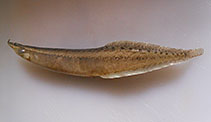
Các tia vây lưng cứng (tổng cộng) : 26 - 30; Các vây lưng mềm (tổng cộng) : 62 - 65; Tia cứng vây hậu môn: 3; Tia mềm vây hậu môn: 56 - 62. Macrognathus albus can be distinguished by the following characters: absence of any bands or bars on body; 26- 29 irregular blotches on mid dorsal line from top of operculum to base of caudal; absence of pre-orbital spine; spinous part of dorsal fin originating considerably behind the end of pectoral fin; head longer and deeper, eyes located closely, body width lesser, pre dorsal and pre anal distances greater (Ref. 97143).
The type locality, Manimala River, is highly sinuous and generally rocky with deep pools at certain locations and sand deposit occurring as sporadic patches or fillings in the pools. It has more or less scanty riparian vegetation. The river has bed materials generally of coarser grade and very low sand content. The width of the river channel ranges from 45-110 m and water depth in the active channel during summer seasons ranges from 0.5 m-3 m. This species occurs together with the following fish species: Anguilla bengalensis, Salmostoma boopis, Danio malabaricus, Barilius bakeri, Gonoproktopterus kurali, Rasbora daniconius, Puntius mahecola, Haludaria fasciatus, Pethia ticto, Dawkinsia filamentosa, Systomus subnasutus, Batasio travancoria, Ompok malabaricus, Clarias dussumieri, Heteropneustes fossilis, Mesonoemacheilus triangularis, Bhavania australis, Xenentodon cancila, Aplocheilus lineatus, Parambassis thomassi, Etroplus maculatus, Etroplus suratensis, Anabas testudineus, Pristolepis malabaricus, Mastacembelus armatus, Macrognathus guentheri, etc. (Ref. 97143).
Vòng đời và hành vi giao phối
Chín muồi sinh dục | Sự tái sinh sản | Đẻ trứng | Các trứng | Sự sinh sản | Ấu trùng
Plamoottil, M. and N.P. Abraham, 2014. Macrognathus albus (order: Synbranchiformes; family: Mastacembelidae), a new fish species from Kerala, India. Intl. J. Pure Appl. Zool. 2(2):100-105. (Ref. 97143)
Tình trạng Sách đỏ IUCN (Ref. 130435: Version 2025-2 (Global))
Mối đe dọa đối với con người
Harmless
Sử dụng của con người
Các nghề cá: không ích lợi (thú vị)
Các công cụ
Báo cáo đặc biệt
Tải xuống XML
Các nguồn internet
Ước tính dựa trên mô hình
Chỉ số đa dạng phát sinh loài (Tài liệu tham khảo
82804): PD
50 = 0.5000 [Uniqueness, from 0.5 = low to 2.0 = high].
Bayesian length-weight: a=0.00427 (0.00189 - 0.00961), b=3.02 (2.81 - 3.23), in cm total length, based on LWR estimates for this (Sub)family-body shape (Ref.
93245).
Mức dinh dưỡng (Tài liệu tham khảo
69278): 3.3 ±0.4 se; based on size and trophs of closest relatives
Thích nghi nhanh (Tài liệu tham khảo
120179): Chiêù cao, thời gian nhân đôi của chủng quần tối thiểu là dưới 15 tháng (Preliminary K or Fecundity.).
Sự dễ bị tổn thương của nghề đánh cá (Ref.
59153): Low vulnerability (16 of 100).
🛈