Classification / Noms
Noms communs | Synonymes | Catalog of Fishes(Genre, Espèce) | ITIS | CoL | WoRMS | Cloffa
>
Cyprinodontiformes (Rivulines, killifishes and live bearers) >
Rivulidae (Rivulines) > Cynolebiinae
Etymology: Cynolebias: Greek, kyon = dog + Greek, odous = teeth + Greek, lebias = a kind of small fish (Ref. 45335); oticus: From the Greek adjective oticus, meaning relative to ear, in reference to the continuous otic and post-otic series of neuromasts, which is diagnostic for this species.
Environnement : milieu / zone climatique / profondeur / gamme de distribution
Écologie
; eau douce benthopélagique. Tropical
South America: Verde river drainage, São Francisco River basin in Brazil.
Taille / Poids / Âge
Maturité: Lm ? range ? - ? cm
Max length : 8.2 cm SL mâle / non sexé; (Ref. 97357); 7.1 cm SL (female)
Description synthétique
Clés d'identification | Morphologie | Morphométrie
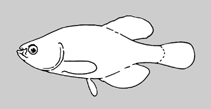
Rayons mous dorsaux (Total) : 15 - 18; Rayons mous anaux: 18 - 21; Vertèbres: 35 - 36. Cynolebias oticus can be diagnosed from all species of the C. perforatus group by having the otic and post-otic series of neuromasts often united, in close proximity when not united (vs. separated by interspace) and dorsal profile of the head always concave (vs. not concave at least in larger males above 7 cm SL (Ref. 97357).
Body shape (shape guide): fusiform / normal.
Occurs in temporary pools of the Verde river drainage, near the village of Pindaí. The region has been highly deforested in recent years, resulting to the extinction of some seasonal killifishes (Cynolebias gilbertoi, C. leptocephalus, Hypsolebias fulminantis) previously inhabiting the area. C. oticus can still be easily found in the area even under such condition (Ref. 97357).
Cycle de vie et comportement reproducteur
Maturité | Reproduction | Frai | Œufs | Fécondité | Larves
Costa, W.J.E.M., 2014. Six new species of seasonal killifishes of the genus Cynolebias from the São Francisco river basin, Brazilian Caatinga, with notes on C. porosus (Cyprinodontiformes: Rivulidae). Ichthyol. Explor. Freshwat. 25(1):79-96. (Ref. 97357)
Statut dans la liste rouge de l'IUCN (Ref. 130435: Version 2025-2 (Global))
Menace pour l'homme
Harmless
Utilisations par l'homme
Outils
Articles particuliers
Télécharger en XML
Sources Internet
Estimations basées sur des modèles
Indice de diversité phylogénétique (Réf.
82804): PD
50 = 0.5000 [Uniqueness, from 0.5 = low to 2.0 = high].
Bayesian length-weight: a=0.01122 (0.00514 - 0.02450), b=3.04 (2.87 - 3.21), in cm total length, based on all LWR estimates for this body shape (Ref.
93245).
Niveau trophique (Réf.
69278): 3.3 ±0.4 se; based on size and trophs of closest relatives
Résilience (Réf.
120179): Haut, temps minimum de doublement de population inférieur à 15 mois (Preliminary K or Fecundity.).
Vulnérabilité de la pêche (Ref.
59153): Low vulnerability (10 of 100).
🛈