Klassifizierung / Names
Namen | Synonyme | Catalog of Fishes(Gattung, Arten) | ITIS | CoL | WoRMS | Cloffa
>
Cyprinodontiformes (Rivulines, killifishes and live bearers) >
Rivulidae (Rivulines) > Cynolebiinae
Etymology: Cynolebias: Greek, kyon = dog + Greek, odous = teeth + Greek, lebias = a kind of small fish (Ref. 45335); oticus: From the Greek adjective oticus, meaning relative to ear, in reference to the continuous otic and post-otic series of neuromasts, which is diagnostic for this species.
Umwelt: Milieu / Klimazone / Tiefenbereich / Verbreitungsgebiet
Ökologie
; süßwasser benthopelagisch. Tropical
South America: Verde river drainage, São Francisco River basin in Brazil.
Größe / Gewicht / Alter
Geschlechtsreife: Lm ? range ? - ? cm
Max length : 8.2 cm SL Männchen/unbestimmt; (Ref. 97357); 7.1 cm SL (female)
Kurzbeschreibung
Bestimmungsschlüssel | Morphologie | Morphometrie
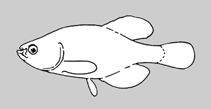
Rückenflossenweichstrahlen (insgesamt) : 15 - 18; Afterflossenweichstrahlen: 18 - 21; Wirbelzahl: 35 - 36. Cynolebias oticus can be diagnosed from all species of the C. perforatus group by having the otic and post-otic series of neuromasts often united, in close proximity when not united (vs. separated by interspace) and dorsal profile of the head always concave (vs. not concave at least in larger males above 7 cm SL (Ref. 97357).
Body shape (shape guide): fusiform / normal.
Occurs in temporary pools of the Verde river drainage, near the village of Pindaí. The region has been highly deforested in recent years, resulting to the extinction of some seasonal killifishes (Cynolebias gilbertoi, C. leptocephalus, Hypsolebias fulminantis) previously inhabiting the area. C. oticus can still be easily found in the area even under such condition (Ref. 97357).
Lebenszyklus und Paarungsverhalten
Geschlechtsreife | Fortpflanzung | Ablaichen | Eier | Fruchtbarkeit | Larven
Costa, W.J.E.M., 2014. Six new species of seasonal killifishes of the genus Cynolebias from the São Francisco river basin, Brazilian Caatinga, with notes on C. porosus (Cyprinodontiformes: Rivulidae). Ichthyol. Explor. Freshwat. 25(1):79-96. (Ref. 97357)
IUCN Rote Liste Status (Ref. 130435: Version 2025-2 (Global))
Bedrohung für Menschen
Harmless
Nutzung durch Menschen
Tools
Zusatzinformationen
Download XML
Internet Quellen
Schätzungen auf der Grundlage von Modellen
Phylogenetischer Diversitätsindex (Ref.
82804): PD
50 = 0.5000 [Uniqueness, from 0.5 = low to 2.0 = high].
Bayesian length-weight: a=0.01122 (0.00514 - 0.02450), b=3.04 (2.87 - 3.21), in cm total length, based on all LWR estimates for this body shape (Ref.
93245).
Trophische Ebene (Ref.
69278): 3.3 ±0.4 se; based on size and trophs of closest relatives
Widerstandsfähigkeit (Ref.
120179): hoch, Verdopplung der Population dauert weniger als 15 Monate. (Preliminary K or Fecundity.).
Anfälligkeit der Fischerei (Ref.
59153): Low vulnerability (10 of 100).
🛈