Klassifizierung / Names
Namen | Synonyme | Catalog of Fishes(Gattung, Arten) | ITIS | CoL | WoRMS | Cloffa
Elasmobranchii (Haie und Rochen) (sharks and rays) >
Carcharhiniformes (Ground sharks) >
Scyliorhinidae (Cat sharks) > Scyliorhininae
Etymology: Scyliorhinus: skylion, Greek for dogfish or small shark; rhinus, from rhine (Gr.), rasp, alluding to a shark’s jagged, rasp-like skin (See ETYFish); cabofriensis: -ensis, Latin suffix denoting place: off Cabo Frio, northeastern Rio de Janeiro State, Brazil, type locality (See ETYFish).
Umwelt: Milieu / Klimazone / Tiefenbereich / Verbreitungsgebiet
Ökologie
seewasser pelagic-neritic; tiefenbereich ? - 536 m (Ref. 107325). Tropical
Verbreitung
Territorien | FAO Gebiete | Ökosysteme | Vorkommen | Punkt Karte | Einführungen | Faunafri
Southwest Atlantic: Brazil.
Größe / Gewicht / Alter
Geschlechtsreife: Lm ? range ? - ? cm
Max length : 46.8 cm TL Männchen/unbestimmt; (Ref. 107325); 45.0 cm TL (female)
Kurzbeschreibung
Bestimmungsschlüssel | Morphologie | Morphometrie
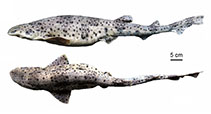
This species is distinguished from its congeners in SW Atlantic by the following characters: color pattern with randomly and asymmetrically distributed black and white spots of varied sizes (predominantly small) (vs. spots predominantly within saddles and with approximate bilateral symmetry in S. haeckelii, S. ugoi); saddles not well defined and without sharp median projections (vs. well-defined saddles in S. haeckelii and saddles with sharp median projections in S. ugoi); claspers with a well-developed groove on the terminal portion of the ventral terminal cartilage (vs. absent or undeveloped groove in S. haeckelii, S. ugoi); no envelope and poorly developed exorhipidion (vs. with envelope and developed exorhipidion in S. haeckelii); neurocranium with a proportionately broader basal plate (vs. narrow basal plate in S. haeckelii, S. ugoi); other characters, although less conspicuous, also distinguishes these species: small and rounded snout, mean preoral length 5% TL (vs. mean 4.5% TL in S. haeckelii); moderately broad and depressed head with its length 19.7-20.8% TL (vs. 17.5-19.2% TL in S. haeckelii); first dorsal fin triangular, never subrectangular (vs. sometimes subrectangular in S. haeckelii); interdorsal space 2 times dorsal-caudal space (vs. 1.2-2 times in S. haeckelii, 2.1-2.5 in S. ugoi); ventral terminal 2 cartilage slender, positioned on ventral terminal cartilage, 1.5 times length of ventral terminal cartilage (vs. 1.8 times in S. haeckelii); components of clasper proportionately larger than in S. haeckelii; somewhat small sized adult males, about 39.3 cm TL, and adult females, at least 42.0 cm TL (vs. 44.5 cm and 50.0 cm TL, respectively, in S. ugoi) (Ref. .107325).
Body shape (shape guide): elongated; Cross section: circular.
Males of this species range in size from 30.8-46.8 cm (n = 8) and females from 27.6-45.0 cm (n = 16). Size of first maturity not exactly defined, however, males have well-developed claspers at 39.3 cm TL and egg-capsules and other evidence that would help establish size of maturity in females without dissection have not been found. Stomach contents include squid beaks and skeletal elements of bony fishes (Ref. 107325).
Lebenszyklus und Paarungsverhalten
Geschlechtsreife | Fortpflanzung | Ablaichen | Eier | Fruchtbarkeit | Larven
Soares, K.D.A., U.L. Gomes and M.R. de Carvalho, 2016. Taxonomic review of catsharks of the Scyliorhinus haeckelii group, with the description of a new species (Chondrichthyes: Carcharhiniformes: Scyliorhinidae). Zootaxa 4066(5):501-534. (Ref. 107325)
IUCN Rote Liste Status (Ref. 130435: Version 2025-2 (Global))
Bedrohung für Menschen
Harmless
Nutzung durch Menschen
Tools
Zusatzinformationen
Download XML
Internet Quellen
Schätzungen auf der Grundlage von Modellen
Phylogenetischer Diversitätsindex (Ref.
82804): PD
50 = 0.5000 [Uniqueness, from 0.5 = low to 2.0 = high].
Bayesian length-weight: a=0.00269 (0.00140 - 0.00518), b=3.21 (3.04 - 3.38), in cm total length, based on LWR estimates for this (Sub)family-body shape (Ref.
93245).
Trophische Ebene (Ref.
69278): 3.8 ±0.5 se; based on size and trophs of closest relatives
Widerstandsfähigkeit (Ref.
120179): niedrig, Verdopplung der Population dauert 4,5 - 14 Jahre. (Preliminary low fecundity).
Anfälligkeit der Fischerei (Ref.
59153): Moderate vulnerability (37 of 100).
🛈