Lớp phụ Cá sụn (cá mập và cá đuối) (sharks and rays) >
Carcharhiniformes (Ground sharks) >
Scyliorhinidae (Cat sharks) > Scyliorhininae
Etymology: Scyliorhinus: skylion, Greek for dogfish or small shark; rhinus, from rhine (Gr.), rasp, alluding to a shark’s jagged, rasp-like skin (See ETYFish); cabofriensis: -ensis, Latin suffix denoting place: off Cabo Frio, northeastern Rio de Janeiro State, Brazil, type locality (See ETYFish).
Môi trường: môi trường / vùng khí hậu / Mức độ sâu / phạm vi phân phối
Sinh thái học
biển pelagic-neritic; mức độ sâu ? - 536 m (Ref. 107325). Tropical
Sự phân bố
Lãnh thổ | Các khu vực của FAO | Các hệ sinh thái | Những lần xuất hiện | Bản đồ điểm | Những chỉ dẫn | Faunafri
Southwest Atlantic: Brazil.
Bộ gần gũi / Khối lượng (Trọng lượng) / Tuổi
Chín muồi sinh dục: Lm ? range ? - ? cm
Max length : 46.8 cm TL con đực/không giới tính; (Ref. 107325); 45.0 cm TL (female)
Mô tả ngắn gọn
Khóa để định loại | Hình thái học | Sinh trắc học
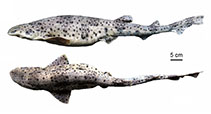
This species is distinguished from its congeners in SW Atlantic by the following characters: color pattern with randomly and asymmetrically distributed black and white spots of varied sizes (predominantly small) (vs. spots predominantly within saddles and with approximate bilateral symmetry in S. haeckelii, S. ugoi); saddles not well defined and without sharp median projections (vs. well-defined saddles in S. haeckelii and saddles with sharp median projections in S. ugoi); claspers with a well-developed groove on the terminal portion of the ventral terminal cartilage (vs. absent or undeveloped groove in S. haeckelii, S. ugoi); no envelope and poorly developed exorhipidion (vs. with envelope and developed exorhipidion in S. haeckelii); neurocranium with a proportionately broader basal plate (vs. narrow basal plate in S. haeckelii, S. ugoi); other characters, although less conspicuous, also distinguishes these species: small and rounded snout, mean preoral length 5% TL (vs. mean 4.5% TL in S. haeckelii); moderately broad and depressed head with its length 19.7-20.8% TL (vs. 17.5-19.2% TL in S. haeckelii); first dorsal fin triangular, never subrectangular (vs. sometimes subrectangular in S. haeckelii); interdorsal space 2 times dorsal-caudal space (vs. 1.2-2 times in S. haeckelii, 2.1-2.5 in S. ugoi); ventral terminal 2 cartilage slender, positioned on ventral terminal cartilage, 1.5 times length of ventral terminal cartilage (vs. 1.8 times in S. haeckelii); components of clasper proportionately larger than in S. haeckelii; somewhat small sized adult males, about 39.3 cm TL, and adult females, at least 42.0 cm TL (vs. 44.5 cm and 50.0 cm TL, respectively, in S. ugoi) (Ref. .107325).
Body shape (shape guide): elongated; Cross section: circular.
Males of this species range in size from 30.8-46.8 cm (n = 8) and females from 27.6-45.0 cm (n = 16). Size of first maturity not exactly defined, however, males have well-developed claspers at 39.3 cm TL and egg-capsules and other evidence that would help establish size of maturity in females without dissection have not been found. Stomach contents include squid beaks and skeletal elements of bony fishes (Ref. 107325).
Vòng đời và hành vi giao phối
Chín muồi sinh dục | Sự tái sinh sản | Đẻ trứng | Các trứng | Sự sinh sản | Ấu trùng
Soares, K.D.A., U.L. Gomes and M.R. de Carvalho, 2016. Taxonomic review of catsharks of the Scyliorhinus haeckelii group, with the description of a new species (Chondrichthyes: Carcharhiniformes: Scyliorhinidae). Zootaxa 4066(5):501-534. (Ref. 107325)
Tình trạng Sách đỏ IUCN (Ref. 130435: Version 2025-2 (Global))
Mối đe dọa đối với con người
Harmless
Sử dụng của con người
Các công cụ
Báo cáo đặc biệt
Tải xuống XML
Các nguồn internet
Ước tính dựa trên mô hình
Chỉ số đa dạng phát sinh loài (Tài liệu tham khảo
82804): PD
50 = 0.5000 [Uniqueness, from 0.5 = low to 2.0 = high].
Bayesian length-weight: a=0.00269 (0.00140 - 0.00518), b=3.21 (3.04 - 3.38), in cm total length, based on LWR estimates for this (Sub)family-body shape (Ref.
93245).
Mức dinh dưỡng (Tài liệu tham khảo
69278): 3.8 ±0.5 se; based on size and trophs of closest relatives
Thích nghi nhanh (Tài liệu tham khảo
120179): thấp, thời gian nhân đôi của chủng quần tối thiểu là 4.5 - 14 năm (Preliminary low fecundity).
Sự dễ bị tổn thương của nghề đánh cá (Ref.
59153): Moderate vulnerability (37 of 100).
🛈