>
Gobiiformes (Gobies) >
Gobiidae (Gobies) > Gobiinae
Etymology: Trimma: Greek, trimma, -atos = something crushed (Ref. 45335); capostriatum: Not given in this paper.
Environnement : milieu / zone climatique / profondeur / gamme de distribution
Écologie
marin récifal; profondeur 1 - 22 m (Ref. 100726). Tropical
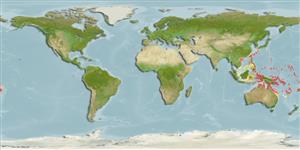
Southwest Pacific: Australia (GBR), New Caledonia, Vanuatu, the Solomons, the Bismark Archipelago, northern and southern New Guinea and Palau (Helen Reef).
Taille / Poids / Âge
Maturité: Lm ? range ? - ? cm
Max length : 2.9 cm SL mâle / non sexé; (Ref. 100726)
Description synthétique
Clés d'identification | Morphologie | Morphométrie
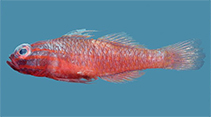
Épines dorsales (Total) : 7; Rayons mous dorsaux (Total) : 8 - 10; Épines anales: 1; Rayons mous anaux: 8. This species is distinguished by the following characters: presence of a deep trough in the bony interorbital region about half pupil-diameter in width; with a shallow trough behind the eye along the upper half of the posterodorsal margin of the eye; naked predorsal midline, sides of nape is scaled to just behind the eye; no scales on cheek and opercle; the pelvic fins is connected by a basal membrane reaching to the tips of fifth ray, forming an indented plate; central 4-11 pectoral rays are branched; 5-6 light stripes (orange to red in life) on head and with dark blue interspaces, the body light with distinct scattered oval or round spots (yellowish-orange, orange or reddish in life); the snout is mostly darkly pigmented without distinct stripes in preserved material, but with orange stripes in life; the upper lip largely dark, except posteriorly, usually with orange stripes from the eye obscured by dark pigment on the jaws; uniformly dark lower lip; lower surface of the head with a black curved stripe and with a median black bar connecting to the lower lip; branchiostegal membranes are predominantly light, except for the stripe and the inner margin of the membranes (Ref. 100726).
Body shape (shape guide): elongated; Cross section: compressed.
Common on middle and outer reefs (Ref. 100726).
Cycle de vie et comportement reproducteur
Maturité | Reproduction | Frai | Œufs | Fécondité | Larves
Winterbottom, R. and D.F. Hoese, 2015. A revision of the Australian species of Trimma (Actinopterygii, Gobiidae), with descriptions of six new species and redescriptions of twenty-three valid species. Zootaxa 3934(1):001-102. (Ref. 100726)
Statut dans la liste rouge de l'IUCN (Ref. 130435: Version 2025-2 (Global))
Menace pour l'homme
Harmless
Utilisations par l'homme
Pêcheries: sans intérêt
Outils
Articles particuliers
Télécharger en XML
Sources Internet
Estimations basées sur des modèles
Indice de diversité phylogénétique (Réf.
82804): PD
50 = 0.5000 [Uniqueness, from 0.5 = low to 2.0 = high].
Bayesian length-weight: a=0.00741 (0.00347 - 0.01582), b=3.09 (2.91 - 3.27), in cm total length, based on LWR estimates for this (Sub)family-body shape (Ref.
93245).
Résilience (Réf.
120179): Haut, temps minimum de doublement de population inférieur à 15 mois (Preliminary K or Fecundity.).
Vulnérabilité de la pêche (Ref.
59153): Low vulnerability (10 of 100).
🛈