This website uses cookies to enhance your browsing experience and ensure the functionality of our site. For more detailed information about the types of cookies we use and how we protect your privacy, please visit our Privacy Information page.
×
Cookie Settings
This website uses different types of cookies to enhance your experience. Please select your preferences below:
Himantura australis, Australian whipray : fisheries
Western Central Pacific: confined to the Australasian Plate, from off Papua New Guinea and northern Australia, from Shark Bay (off Western Australia) to Brisbane (off Queensland) (Ref. 110363). Also Ref. 114953.
大小 / 重量 / 年齡
成熟度: Lm? range ? - ? cm Max length : 140.0 cm WD (female)
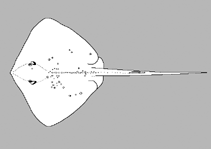
This species is distinguished by the following set of characters: the disc is weakly rhomboidal; preorbital snout is moderately short, its length 19-22% DW and rather broad, angle 117-127°, with a distinct apical lobe; lateral apices are narrowly rounded; the orbits moderately large, usually strongly protruding (particularly in young); 1-2, mostly heart-shaped suprascapular denticles which are not preceded before and after by a row of smaller primary denticles; secondary denticle band is developed before birth; dorsal surface of juveniles (smaller than 370 mm DW) are dark spotted or with spots and weak reticulations, subadults and adults (exceeding 390 mm DW) are more strongly reticulated; dorsal tail of juveniles has 3 rows of spots before caudal sting, faint dark saddles beyond sting (no alternating black and white bands on tail); tail uniformly dark ventrally; 146-152 pectoral-fin radials; 123 vertebral centra (excluding synarcual), 24 including synarcual 124 (Ref. 110363)
Body shape (shape guide): other (see remarks); Cross section: flattened.
Depth distribution is not well documented, but this species is primarily in shallow water from near the shore to at least 45 m depth (Ref. 110363). Enters estuaries and brackish water. Most serious injuries to humans come from stingray groups (Ref. 114953). The largest specimen (140 cm WD) is a pregnant female with 2 embryos (30 cm WD) (data not year published); the smallest confirmed adult male is 112 cm WD (Ref. 110363); born at ca. 29 cm WD. Produces litters up to 4 pups (Ref. 114953).
Last, P.R., W.T. White and G. Naylor, 2016. Three new stingrays (Myliobatiformes: Dasyatidae) from the Indo-West Pacific. Zootaxa 4147(4):377-402. (Ref. 110363)
系統發育多樣性指數 (參考文獻 82804): PD50 = 0.5002 [Uniqueness, from 0.5 = low to 2.0 = high].
Bayesian length-weight: a=0.01023 (0.00482 - 0.02174), b=3.06 (2.86 - 3.26), in cm total length, based on LWR estimates for this (Sub)family-body shape (Ref. 93245).
營養階層 (參考文獻 69278): 3.6 ±0.5 se; based on size and trophs of closest relatives
釣魚的脆弱性 (Ref. 59153): Very high vulnerability (90 of 100). 🛈