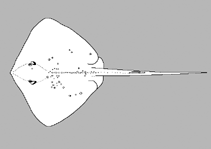
Elasmobranquios (tiburones y rayas) (sharks and rays) >
Myliobatiformes (Stingrays) >
Dasyatidae (Stingrays) > Urogymninae
Etymology: Himantura: Greek, iman, imantos = thong, strap + Greek, oura = tail (Ref. 45335); australis: Named for the tropical Southern Hemisphere distribution of this species; noun in apposition.
Entorno: milieu / zona climática / rango de profundidad / gama de distribución
Ecología
marino demersal; rango de profundidad ? - 45 m (Ref. 110363). Tropical; 5°S - 29°S, 111°E - 155°E (Ref. 114953)
Western Central Pacific: confined to the Australasian Plate, from off Papua New Guinea and northern Australia, from Shark Bay (off Western Australia) to Brisbane (off Queensland) (Ref. 110363). Also Ref. 114953.
Tamaño / Peso / Edad
Madurez: Lm ? range ? - ? cm
Max length : 140.0 cm WD (female)
Descripción breve
Claves de identificación | Morfología | Morfometría
This species is distinguished by the following set of characters: the disc is weakly rhomboidal; preorbital snout is moderately short, its length 19-22% DW and rather broad, angle 117-127°, with a distinct apical lobe; lateral apices are narrowly rounded; the orbits moderately large, usually strongly protruding (particularly in young); 1-2, mostly heart-shaped suprascapular denticles which are not preceded before and after by a row of smaller primary denticles; secondary denticle band is developed before birth; dorsal surface of juveniles (smaller than 370 mm DW) are dark spotted or with spots and weak reticulations, subadults and adults (exceeding 390 mm DW) are more strongly reticulated; dorsal tail of juveniles has 3 rows of spots before caudal sting, faint dark saddles beyond sting (no alternating black and white bands on tail); tail uniformly dark ventrally; 146-152 pectoral-fin radials; 123 vertebral centra (excluding synarcual), 24 including synarcual 124 (Ref. 110363)
Body shape (shape guide): other (see remarks); Cross section: flattened.
Depth distribution is not well documented, but this species is primarily in shallow water from near the shore to at least 45 m depth (Ref. 110363). Enters estuaries and brackish water. Most serious injuries to humans come from stingray groups (Ref. 114953). The largest specimen (140 cm WD) is a pregnant female with 2 embryos (30 cm WD) (data not year published); the smallest confirmed adult male is 112 cm WD (Ref. 110363); born at ca. 29 cm WD. Produces litters up to 4 pups (Ref. 114953).
Ciclo vital y comportamiento de apareamiento
Madurez | Reproducción | Puesta | Huevos | Fecundidad | Larva
Last, P.R., W.T. White and G. Naylor, 2016. Three new stingrays (Myliobatiformes: Dasyatidae) from the Indo-West Pacific. Zootaxa 4147(4):377-402. (Ref. 110363)
Situación en la Lista Roja de la UICN (Ref. 130435: Version 2025-2 (Global))
Amenaza para el ser humano
Usos humanos
Pesquerías: escaso valor comercial
Herramientas
Informes especiales
Descargar XML
Fuentes de Internet
Estimaciones basadas en modelos
Índice de diversidad filogenética (Referencia
82804): PD
50 = 0.5002 [Uniqueness, from 0.5 = low to 2.0 = high].
Bayesian length-weight: a=0.01023 (0.00482 - 0.02174), b=3.06 (2.86 - 3.26), in cm total length, based on LWR estimates for this (Sub)family-body shape (Ref.
93245).
Nivel trófico (Referencia
69278): 3.6 ±0.5 se; based on size and trophs of closest relatives
Vulnerabilidad pesquera (Ref.
59153): Very high vulnerability (90 of 100).
🛈