Klassifizierung / Names
Namen | Synonyme | Catalog of Fishes(Gattung, Arten) | ITIS | CoL | WoRMS | Cloffa
>
Siluriformes (Catfishes) >
Loricariidae (Armored catfishes) > Hypoptopomatinae
Etymology: Rhinotocinclus: Greek, 'Pnivqc' (Rhinos) = beak, snout + Greek, 'Otocinclus' = a genus of Hypoptopomatinae; in reference to the conspicuous and elegant snout of most of its species (Ref. 128924); variola: Named from the Latin variola, meaning smallpox, spotted, in allusion to the dark dots
that cover all dorsal and ventral body surfaces. A noun in apposition.
Umwelt: Milieu / Klimazone / Tiefenbereich / Verbreitungsgebiet
Ökologie
; süßwasser demersal. Tropical
South America: Quebrada Tacana, a tributary to the Amazon River in Colombia.
Größe / Gewicht / Alter
Geschlechtsreife: Lm ? range ? - ? cm
Max length : 2.9 cm SL Männchen/unbestimmt; (Ref. 100824)
Kurzbeschreibung
Bestimmungsschlüssel | Morphologie | Morphometrie
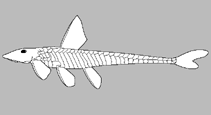
Rückenflossenstacheln (insgesamt) : 1; Rückenflossenweichstrahlen (insgesamt) : 7; Afterflossenweichstrahlen: 6. Parotocinclus variola can be distinguished from all other congeners from northeastern to southeastern Brazilian rivers in having the cheek canal plate elongated posteriorly on the ventral surface of head and contacting the cleithrum. It differs from P. collinsae (Essequibo River basin, Guiana) and P. halbothi (rio Trombetas basin, Brazil and Marowijne River, Suriname), by the presence of a triangular patch of dark pigmentation on the anterior portion of the
dorsal-fin membrane, by the absence of unicuspid accessory teeth on both the premaxilla and dentary, and by having a Y-shaped light mark on the snout . It can be separated from all other species of Parotocinclus from Amazon, Orinoco and the Guianas by possessing a pigmentation pattern consisting of conspicuous dark dots smaller than a pupil diameter, broadly distributed dorsally and ventrally. It further differs from P. eppleyi (Orinoco basin), P. longirostris, P. amazonensis (Amazon basin) and P. britskii (Orinoco and coastal drainages of the Guianas) by having the central abdominal plates arranged in a single series between the lateral abdominal plates, from the coracoid to the preanal plate and with a wide naked area at the pelvic-fin base (vs. arranged in two or more series between the lateral abdominal plates and without wide naked area at the pelvic-fin base). It can be further diagnosed from P. eppleyi, P. longirostris, and P. polyochrus by having a Y-shaped, light mark on the snout only (vs. Y-shaped, light mark present on both the snout and head). It can be further distinguished from its congeners in having more oral teeth: 38-46 premaxillary and 39- 46 dentary teeth (Ref. 100824).
Body shape (shape guide): elongated.
Facultative air-breathing in the genus (Ref. 126274); Occurs in Quebrada Tacana, a blackwater creek with sandy bottom. Average rainfall
in the sampling area is 3,400 mm/year and average temperature is 25.5° C (Ref. 100824).
Lebenszyklus und Paarungsverhalten
Geschlechtsreife | Fortpflanzung | Ablaichen | Eier | Fruchtbarkeit | Larven
Lehmann, A.P., L.J. Schvambach and R.E. Reis, 2015. A new species of the armored catfish Parotocinclus (Loricariidae: Hypoptopomatinae), from the Amazon basin in Colombia. Neotrop. Ichthyol. 13(1):47-52. (Ref. 100824)
IUCN Rote Liste Status (Ref. 130435: Version 2025-2 (Global))
Bedrohung für Menschen
Harmless
Nutzung durch Menschen
Tools
Zusatzinformationen
Download XML
Internet Quellen
Schätzungen auf der Grundlage von Modellen
Phylogenetischer Diversitätsindex (Ref.
82804): PD
50 = 0.5156 [Uniqueness, from 0.5 = low to 2.0 = high].
Bayesian length-weight: a=0.00977 (0.00434 - 0.02202), b=3.06 (2.87 - 3.25), in cm total length, based on LWR estimates for this (Sub)family-body shape (Ref.
93245).
Trophische Ebene (Ref.
69278): 2.5 ±0.1 se; based on size and trophs of closest relatives
Widerstandsfähigkeit (Ref.
120179): hoch, Verdopplung der Population dauert weniger als 15 Monate. (Preliminary K or Fecundity.).
Anfälligkeit der Fischerei (Ref.
59153): Low vulnerability (10 of 100).
🛈