Классификация / Имена
народные названия | синонимы | Catalog of Fishes(род, виды) | ITIS | CoL | WoRMS | Cloffa
>
Siluriformes (Catfishes) >
Loricariidae (Armored catfishes) > Hypoptopomatinae
Etymology: Rhinotocinclus: Greek, 'Pnivqc' (Rhinos) = beak, snout + Greek, 'Otocinclus' = a genus of Hypoptopomatinae; in reference to the conspicuous and elegant snout of most of its species (Ref. 128924); variola: Named from the Latin variola, meaning smallpox, spotted, in allusion to the dark dots
that cover all dorsal and ventral body surfaces. A noun in apposition.
Окружающая среда: среда / климатическая зона / пределы глубины / диапазон распространения
экология
; пресноводный демерсальный. Tropical
South America: Quebrada Tacana, a tributary to the Amazon River in Colombia.
Размер / Вес / Возраст
половая зрелость: Lm ? range ? - ? cm
Max length : 2.9 cm SL самец/пол неопределен; (Ref. 100824)
Краткое описание
определительные ключи | морфология | морфометрия
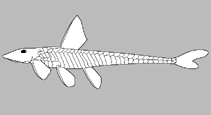
колючие лучи спинного плавника (общее число) : 1; членистые (мягкие) лучи спинного плавника (общее число) : 7; членистые (мягкие) лучи анального плавника: 6. Parotocinclus variola can be distinguished from all other congeners from northeastern to southeastern Brazilian rivers in having the cheek canal plate elongated posteriorly on the ventral surface of head and contacting the cleithrum. It differs from P. collinsae (Essequibo River basin, Guiana) and P. halbothi (rio Trombetas basin, Brazil and Marowijne River, Suriname), by the presence of a triangular patch of dark pigmentation on the anterior portion of the
dorsal-fin membrane, by the absence of unicuspid accessory teeth on both the premaxilla and dentary, and by having a Y-shaped light mark on the snout . It can be separated from all other species of Parotocinclus from Amazon, Orinoco and the Guianas by possessing a pigmentation pattern consisting of conspicuous dark dots smaller than a pupil diameter, broadly distributed dorsally and ventrally. It further differs from P. eppleyi (Orinoco basin), P. longirostris, P. amazonensis (Amazon basin) and P. britskii (Orinoco and coastal drainages of the Guianas) by having the central abdominal plates arranged in a single series between the lateral abdominal plates, from the coracoid to the preanal plate and with a wide naked area at the pelvic-fin base (vs. arranged in two or more series between the lateral abdominal plates and without wide naked area at the pelvic-fin base). It can be further diagnosed from P. eppleyi, P. longirostris, and P. polyochrus by having a Y-shaped, light mark on the snout only (vs. Y-shaped, light mark present on both the snout and head). It can be further distinguished from its congeners in having more oral teeth: 38-46 premaxillary and 39- 46 dentary teeth (Ref. 100824).
Body shape (shape guide): elongated.
Facultative air-breathing in the genus (Ref. 126274); Occurs in Quebrada Tacana, a blackwater creek with sandy bottom. Average rainfall
in the sampling area is 3,400 mm/year and average temperature is 25.5° C (Ref. 100824).
Жизненный цикл и брачное поведение
половая зрелость | размножение | нерест | икра | Плодовитость | личинки
Lehmann, A.P., L.J. Schvambach and R.E. Reis, 2015. A new species of the armored catfish Parotocinclus (Loricariidae: Hypoptopomatinae), from the Amazon basin in Colombia. Neotrop. Ichthyol. 13(1):47-52. (Ref. 100824)
Статус Красного Списка МСОП (Ref. 130435: Version 2025-2 (Global))
Угроза для людей
Harmless
Использование человеком
дополнительная информация
инструменты
Специальные отчеты
Скачать в формате XML
ресурсы в Интернет
Оценки, основанные на моделях
Индекс филогенетического разнообразия (ссылка
82804): PD
50 = 0.5156 [Uniqueness, from 0.5 = low to 2.0 = high].
Bayesian length-weight: a=0.00977 (0.00434 - 0.02202), b=3.06 (2.87 - 3.25), in cm total length, based on LWR estimates for this (Sub)family-body shape (Ref.
93245).
Трофический уровень (ссылка
69278): 2.5 ±0.1 se; based on size and trophs of closest relatives
устойчивость к внешним воздействиям (ссылка
120179): высокий, минимальное время удвоения популяции до 15 месяцев (Preliminary K or Fecundity.).
Уязвимость рыбной ловли (Ref.
59153): Low vulnerability (10 of 100).
🛈