klasifikasi / Nama
Nama-nama umum | Sinonim (persamaan) | Catalog of Fishes(Marga, Jenis) | ITIS | CoL | WoRMS | Cloffa
>
Characiformes (Characins) >
Crenuchidae (South American darters) > Characidiinae
Etymology: Characidium: Diminutive of Charax, -akos = a fish without identification (Ref. 45335); satoi: Named for Dr. Yoshimi Sato, a biologist of the Companhia de Desenvolvivmento dos Vales do São Francisco e do Parnaíba (CODEVASF), for his contributions to the knowledge and conservation of the ichthyofauna of the Rio São Francisco drainage.
Eponymy: Dr Yoshimi Sato is a biologist at Companhia de Desenvolvimento dos Vales do São Francisco e do Parnaíba (CODEVASF) who led research at Três Marias Integrated Fisheries and Aquaculture Center. [...] (Ref. 128868), visit book page.
Lingkungan: lingkungan / zona iklim / kisaran kedalaman / jangkauan distribusi
Ekologi
; air tawar bentopelagis. Tropical
South America: Rio São Francisco basin, Brazil.
Ukuran / Berat / umur
Kematangan: Lm ? range ? - ? cm
Max length : 4.4 cm SL jantan/; (Ref. 104008)
deskripsi pendek
Kunci identifiaksi (pengenalan) | Morfologi | Morfometrik
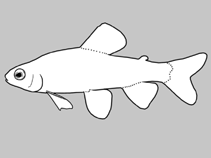
duri punggung lunak (Keseluruhan (total)) : 11; Sirip dubur lunak: 8; vertebrata, bertulang belakang: 34. Characidium satoi is distinguished externally from its congeners by having area between pelvic fin and origin of anal fin moderate to strongly convex in lateral view (vs. area between the pelvic fin and the anal-fin origin straight); and by color pattern, with females, juveniles, and non-breeding males consisting of irregular and discontinuous bars, forming dorsal blotches separated from ventral part, which is V-shaped, W-shaped, or diamond-shaped, or breeding males having less distinct patterning and an overall darker, more uniform pigmentation. It possesses one putative internal autapomorphy, the anteriormost first anal-fin radials inserted between the fifth and sixth caudal vertebrae. Additional external diagnostic characters useful for its identification include the following: isthmus scaled; lateral line complete, with 34-37 perforated scales; anal-fin origin far posterior from anus, separated by 4 to 7 scales (vs. anal-fin origin close to anus, separated from anus by 2 to 4 scales in all congeners, except in C. hasemani, C. litorale , and C. zebra ); distal tip of anal-fin rays reaching base of ventral caudal-fin ray (vs. not reaching, except in C. bahiense, C. hasemani, C. mirim, and C. zebra, and mature males of C. rachovii); and presence of hooks on the pectoral- and pelvic-fin rays in males (vs. absence, except in C. bahiense, C. bimaculatum, C. lagosantense, C. litorale, C. mirim, C. nupelia, C. stigmosum, C. xanthopterum, and C. xavante) (Ref. 104008).
Body shape (shape guide): fusiform / normal.
Found only in a single locality characterized by fast flowing waters with periodic shallow riffles no more than 0.4 m deep alternating with artificial pools more than 2 m deep. Occurs only in the rapids (Ref. 104008).
Siklus hidup dan perilaku kawin
Kematangan | Reproduksi, perkembang biakan | Pemijahan | telur-telur | Fekunditas | Larva
Melo, M.R.S. and O.T. Oyakawa, 2015. A new species of Characidium Reinhardt (Characiformes: Crenuchidae) with a distinctively dimorphic male. Copeia 103(2):281-289. (Ref. 104008)
Status IUCN Red List (Ref. 130435: Version 2025-2 (Global))
ancaman kepada manusia
Harmless
penggunaan manusia
Perikanan: tidak ada kepentingan
Alat, peralatan
laporan khas
muat turun XML
Sumber internet
Estimasi berdasarkan model
Indeks keanekaragaman filogenetik (Acuan
82804): PD
50 = 0.5000 [Uniqueness, from 0.5 = low to 2.0 = high].
Bayesian length-weight: a=0.01122 (0.00514 - 0.02450), b=3.04 (2.87 - 3.21), in cm total length, based on all LWR estimates for this body shape (Ref.
93245).
Tingkat Trofik (Acuan
69278): 3.4 ±0.3 se; based on size and trophs of closest relatives
Kerentanan Penangkapan Ikan (Ref.
59153): Low vulnerability (10 of 100).
🛈