分類 / 名稱
俗名 | 同種異名 | Catalog of Fishes(屬, 種) | ITIS | CoL | WoRMS | Cloffa
Teleostei >
Characiformes (Characins) >
Crenuchidae (South American darters) > Characidiinae
Etymology: Characidium: Diminutive of Charax, -akos = a fish without identification (Ref. 45335); satoi: Named for Dr. Yoshimi Sato, a biologist of the Companhia de Desenvolvivmento dos Vales do São Francisco e do Parnaíba (CODEVASF), for his contributions to the knowledge and conservation of the ichthyofauna of the Rio São Francisco drainage.
Eponymy: Dr Yoshimi Sato is a biologist at Companhia de Desenvolvimento dos Vales do São Francisco e do Parnaíba (CODEVASF) who led research at Três Marias Integrated Fisheries and Aquaculture Center. [...] (Ref. 128868), visit book page.
環境: 環境 / 氣候帶 / 深度上下限 / 配送範圍
生態學
; 淡水 底中水層性.
分布
領土 | FAO區域 | 生態系 | 發現紀錄 | 分布圖 | 簡介 | Faunafri
South America: Rio São Francisco basin, Brazil.
大小 / 重量 / 年齡
成熟度: Lm ? range ? - ? cm
Max length : 4.4 cm SL 雄魚/尚未辨別雌雄; (Ref. 104008)
簡短描述
檢索表 | 型態特徵 | 形態測量圖
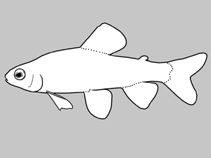
背的軟條 (總數) : 11; 臀鰭軟條: 8; 脊椎骨: 34. Characidium satoi is distinguished externally from its congeners by having area between pelvic fin and origin of anal fin moderate to strongly convex in lateral view (vs. area between the pelvic fin and the anal-fin origin straight); and by color pattern, with females, juveniles, and non-breeding males consisting of irregular and discontinuous bars, forming dorsal blotches separated from ventral part, which is V-shaped, W-shaped, or diamond-shaped, or breeding males having less distinct patterning and an overall darker, more uniform pigmentation. It possesses one putative internal autapomorphy, the anteriormost first anal-fin radials inserted between the fifth and sixth caudal vertebrae. Additional external diagnostic characters useful for its identification include the following: isthmus scaled; lateral line complete, with 34-37 perforated scales; anal-fin origin far posterior from anus, separated by 4 to 7 scales (vs. anal-fin origin close to anus, separated from anus by 2 to 4 scales in all congeners, except in C. hasemani, C. litorale , and C. zebra ); distal tip of anal-fin rays reaching base of ventral caudal-fin ray (vs. not reaching, except in C. bahiense, C. hasemani, C. mirim, and C. zebra, and mature males of C. rachovii); and presence of hooks on the pectoral- and pelvic-fin rays in males (vs. absence, except in C. bahiense, C. bimaculatum, C. lagosantense, C. litorale, C. mirim, C. nupelia, C. stigmosum, C. xanthopterum, and C. xavante) (Ref. 104008).
Body shape (shape guide): fusiform / normal.
Found only in a single locality characterized by fast flowing waters with periodic shallow riffles no more than 0.4 m deep alternating with artificial pools more than 2 m deep. Occurs only in the rapids (Ref. 104008).
生命週期和交配行為
成熟度 | 繁殖 | 產卵場 | 卵 | 孕卵數 | 仔魚
Melo, M.R.S. and O.T. Oyakawa, 2015. A new species of Characidium Reinhardt (Characiformes: Crenuchidae) with a distinctively dimorphic male. Copeia 103(2):281-289. (Ref. 104008)
IUCN 瀕危狀態 (Ref. 130435: Version 2025-2 (Global))
人類使用
漁業: 沒有興趣
工具
特別的報告
下載 XML
網路資源
基於模型的估計
系統發育多樣性指數 (參考文獻
82804): PD
50 = 0.5000 [Uniqueness, from 0.5 = low to 2.0 = high].
Bayesian length-weight: a=0.01122 (0.00514 - 0.02450), b=3.04 (2.87 - 3.21), in cm total length, based on all LWR estimates for this body shape (Ref.
93245).
營養階層 (參考文獻
69278): 3.4 ±0.3 se; based on size and trophs of closest relatives
釣魚的脆弱性 (Ref.
59153): Low vulnerability (10 of 100).
🛈