klasifikasi / Nama
Nama-nama umum | Sinonim (persamaan) | Catalog of Fishes(Marga, Jenis) | ITIS | CoL | WoRMS | Cloffa
>
Siluriformes (Catfishes) >
Auchenipteridae (Driftwood catfishes) > Auchenipterinae
Etymology: Tympanopleura: Greek, tympanon = drum + Greek, pleura = pleura.
Eponymy: Marshall Cândido Mariano da Silva Rondon (1865–1958) was a Brazilian army officer (1881–1955) engineer and explorer, whose Rondon Commission was responsible for installing telegraph poles from Mato Grosso to Amazonas. [...] (Ref. 128868), visit book page.
Lingkungan: lingkungan / zona iklim / kisaran kedalaman / jangkauan distribusi
Ekologi
; air tawar bentopelagis. Tropical
South America: central Amazon River basin, including the rio Madeira in Brazil, and the río Mamoré and río Guaporé in Bolivia.
Ukuran / Berat / umur
Kematangan: Lm ? range ? - ? cm
Max length : 17.4 cm SL jantan/; (Ref. 125975); Berat maksimum terpublikasi: 104.67 g (Ref. 125975)
deskripsi pendek
Kunci identifiaksi (pengenalan) | Morfologi | Morfometrik
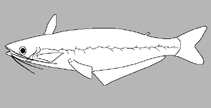
Duri punggung (Keseluruhan (total)) : 2; duri punggung lunak (Keseluruhan (total)) : 6; Sirip dubur lunak: 28 - 37; vertebrata, bertulang belakang: 38 - 42. Tympanopleura rondoni is distinguished by having more robust body shape and larger maximum size (about 160 mm SL) than congeners (all less than 120 mm SL in the material examined). It possesses a unique, prominently spotted pigmentation pattern on the head,
body, and fins, and an elongated gas bladder with two moderately long, recurved terminal posterior diverticula. It can be further diagnosed from T. atronasus in having a greater number of anal-fin rays (28-37, mode 31 vs. 23-30, mode 27), more pectoral-fin rays (10-13 vs. 7-9), more gill rakers on the first arch (24-33 vs. 14-23), fewer preanal vertebrae (14-16, mode 15 vs. 16-19, mode 17), fewer pairs of pleural ribs (4-6 vs. 7-8), greater distance from pectoral- to dorsal-fin origin (19.8-29.0% SL vs. 15.7-20.9% SL), slightly greater body width at pectoral-fin origin (21.8-29.5% SL vs. 17.8-22.9% SL), slightly longer pectoral-fin spine (17.1-21.0% SL vs. 13.3-19.0% SL), and a smaller eye diameter (8.4-17.0% HL vs. 16.0-27.8% HL). It differs from T. brevis in having more gill rakers (24-33, mode 29-30 vs. 20-24, mode 23), a slightly shorter-pectoral fin spine (17.1-21.0% SL vs. 19.1- 24.4% SL), and a smaller eye (8.4-17.0% HL vs. 13.8-21.0% HL); otherwise, these two species are differentiated mainly on the basis of pigmentation pattern and structure of the gas bladder. It is dintict from T. cryptica in having a longer anal fin (anal-fin rays 28-37, mode 31 vs. 23-30, mode 29), more pectoral-fin rays (10-13, mode 11 vs. 8-10, mode 9), more gill rakers (24-33, mode 29-30 vs. 21-26, mode 22), greater number of total vertebrae (38- 42, mode 40 vs. 38-41, mode 38), pleural rib pairs (4-6, mode 6 vs. 4-5, mode 5), and a smaller eye (8.4-17.0% HL vs. 16.7-25.6% HL). It can be separated from T. longipinna in having a somewhat shorter anal fin (anal-fin rays 28-37, mode 31 vs. 32-42, mode 37), more gill rakers (24-33, mode 29-30 vs. 19-25, mode 23), fewer total vertebrae (38-42, mode 40 vs. 40-43, mode 43), pleural rib pairs (4-6, mode 6 vs. 4-5, mode 5), longer predorsal length (35.2-47.4% SL vs. 29.5-36.1% SL), shorter distance from pelvic- to adipose-fin origin (24.0-41.5% SL vs. 37.6-45.1% SL), shorter distance from dorsal- to adipose-fin origin (38.1-46.8% SL vs. 46.5-54.0% SL), and a shorter anal-fin base (23.1-32.5% SL vs. 33.9-39.9% SL). It is distinguisged from T. piperata in having more pectoralfin rays (10-13, mode 11 vs. 6-10, mode 9), more gill rakers (24-33 vs. 16-23), pleural ribs pairs (4-6, mode 6 vs. 4-5, mode 4), longer prepectoral length (29.2-39.0% SL vs. 23.6-28.3% SL), greater distance from pectoral- to dorsal fin origin (19.8-29.0% SL vs. 15.2-20.9% SL), greater body width at pectoral-fin origin (21.8-29.5% SL vs. 16.8-20.0% SL), shorter anal-fin base (23.1-32.5% SL vs. 30.9-39.3% SL), longer head (26.5-39.0% SL vs. 22.2-27.8% SL), longer snout (41.7-53.6% SL vs. 31.4-43.6% SL), proportionally longer jaws and a wider gape, and a smaller eye (8.4-17.0% HL vs. 24.3-35.7% HL) (Ref. 103256).
Siklus hidup dan perilaku kawin
Kematangan | Reproduksi, perkembang biakan | Pemijahan | telur-telur | Fekunditas | Larva
Walsh, S.J., F.R.V. Ribeiro and L.H. Rapp Py-Daniel, 2015. Revision of Tympanopleura Eigenmann (Siluriformes: Auchenipteridae) with description of two new species. Neotrop. Ichthyol. 13(1):1-46. (Ref. 103256)
Status IUCN Red List (Ref. 130435: Version 2025-2 (Global))
ancaman kepada manusia
Harmless
penggunaan manusia
Alat, peralatan
laporan khas
muat turun XML
Sumber internet
Estimasi berdasarkan model
Indeks keanekaragaman filogenetik (Acuan
82804): PD
50 = 0.5156 [Uniqueness, from 0.5 = low to 2.0 = high].
Bayesian length-weight: a=0.01318 (0.00682 - 0.02548), b=3.09 (2.92 - 3.26), in cm total length, based on LWR estimates for this species & (Sub)family-body (Ref.
93245).
Tingkat Trofik (Acuan
69278): 3.4 ±0.4 se; based on size and trophs of closest relatives
Daya lenting (Acuan
120179): Tinggi, Waktu penggandaan populasi minimum kurang dari 15 bulan (Preliminary K or Fecundity.).
Kerentanan Penangkapan Ikan (Ref.
59153): Low vulnerability (11 of 100).
🛈